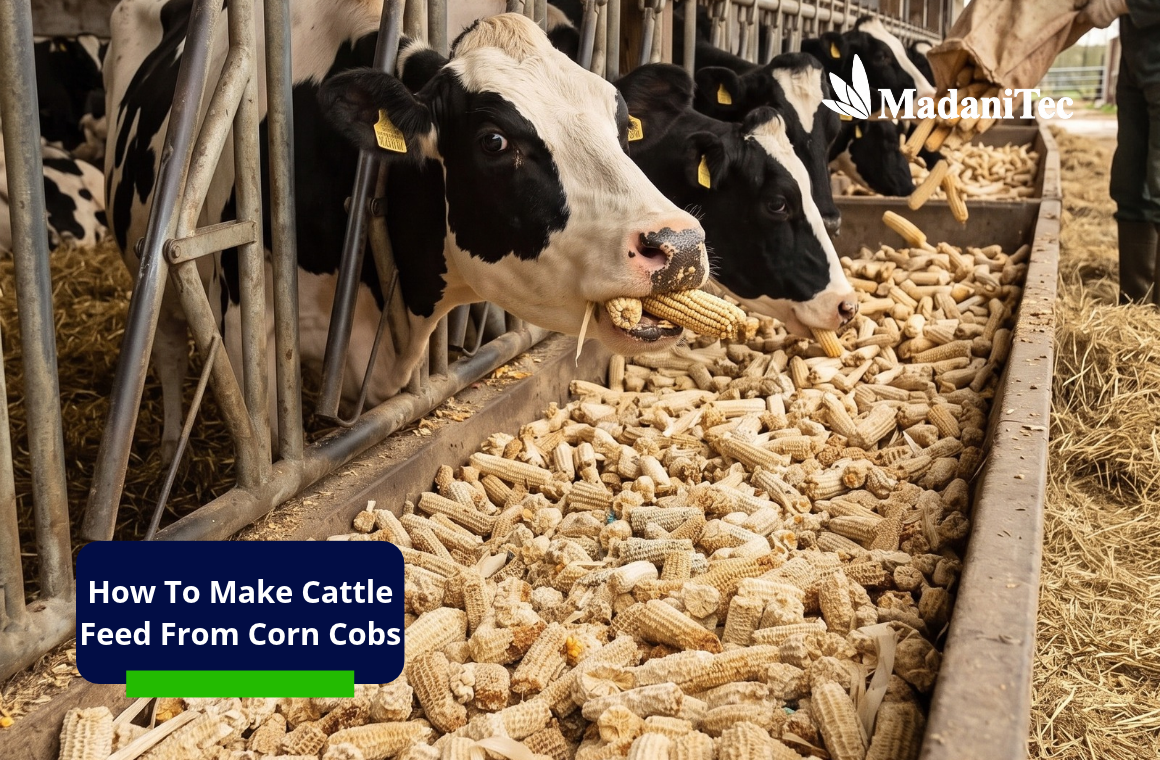
Corn production generates more than just the kernels. After harvesting and processing, farmers are often left with corn cobs that may be treated as agricultural waste. However, these residues still have potential value when properly prepared. One practical approach is to process them as part of livestock feed.
Learning How to make livestock feed from corn cobs can help farmers make better use of agricultural residues while potentially reducing dependence on conventional feed materials. However, corn cobs should be processed properly and combined with other suitable feed ingredients to meet the nutritional needs of cattle.
Can Corn Cobs Be Used as Cattle Feed?
Yes, corn cobs can be utilized as one of the fibrous materials in cattle feed. Their relatively high fiber content makes them potentially useful as part of a broader feed mixture.
However, corn cobs are not nutritionally equivalent to complete cattle feed. Their nutritional value depends on the material itself and how it is processed.
Therefore, farmers should consider corn cobs as one component of a balanced feeding strategy rather than the only feed source.
Processing is also important because whole corn cobs are relatively hard and bulky. Reducing their size can make them easier to handle and mix with other ingredients.
Learn more about: 7 Agricultural Residues That Can Be Used for Livestock Feed
Nutritional Characteristics of Corn Cobs
Corn cobs are mainly associated with structural carbohydrates and fiber. This characteristic can make them useful as a roughage-related ingredient, but their nutritional limitations should also be considered.
The final feed formulation should take into account the cattle’s age, body condition, production purpose, and other available feed ingredients.
Why Processing Is Important
Proper processing can improve handling and make corn cobs more practical to incorporate into feed mixtures. Smaller particles can also be easier to mix with other materials.
Processing should always begin with clean, good-quality raw materials. Moldy, contaminated, or deteriorated corn cobs should not be used.
How to make livestock feed from corn cobs
The process can be relatively simple when farmers have suitable equipment and clean raw materials. The following steps provide a practical overview.
1. Collect and Sort the Corn Cobs
Start by collecting corn cobs from a clean source. Remove soil, stones, plastic, metal, and other foreign materials.
Sort the cobs and separate materials that show signs of mold, unusual discoloration, or serious deterioration. Good-quality raw material is essential for maintaining feed safety.
2. Clean and Dry the Corn Cobs
Clean the selected corn cobs before further processing. If the material contains excessive moisture, drying can help reduce the risk of deterioration during storage.
Proper storage is also important. Processed or dried materials should be kept in a clean, dry, and well-ventilated area.
3. Chop the Corn Cobs into Smaller Pieces
Whole corn cobs can be difficult to handle because of their size and hardness. Chopping them into smaller pieces is therefore an important preparation step.
A suitable chopping process can make the material easier to transport, process, and combine with other feed ingredients.
4. Grind the Corn Cobs into Smaller Particles
After chopping, the material can be reduced further depending on the desired feed formulation.
Grinding can produce a more uniform material that is easier to mix. The appropriate particle size should depend on the feeding system and the other ingredients being used.
For larger-scale operations, appropriate size-reduction equipment can help make the process more consistent and efficient.
5. Mix with Other Suitable Feed Ingredients
This is an important stage because corn cobs should not automatically be considered a complete feed.
They can be combined with other appropriate ingredients to create a feed mixture with a more suitable nutritional profile. The formulation should consider energy, protein, minerals, and other nutritional requirements of the cattle.
Farmers should also avoid making major changes to cattle diets without considering the animals’ nutritional needs.
6. Apply Appropriate Treatment When Needed
Some agricultural residues may undergo additional treatments, such as fermentation, before being incorporated into feed.
However, treatment methods should be selected carefully according to the characteristics of the material and the intended feeding system.
Fermentation should not be treated as a universal requirement, and poor processing can create additional safety problems.
What Are the Benefits of Using Corn Cobs for Cattle Feed?
Using corn cobs as part of a feed system can provide several potential benefits for farmers.
Reducing Agricultural Waste
Instead of leaving corn cobs unused after harvest, farmers can explore ways to give this residue an additional purpose.
Making Better Use of Corn Residues
Processing agricultural residues can increase their practical value and support more efficient resource utilization on farms.
Potentially Reducing Feed Costs
If suitable corn residues are readily available locally, their use as one component of feed may help farmers reduce dependence on some externally purchased materials.
The actual economic benefit, however, depends on processing costs, availability, feed formulation, and local prices.
Supporting a More Circular Farming System
Using crop residues for other agricultural purposes supports the idea of a more circular farming system, where materials generated from one activity can become useful inputs for another.
What Should Farmers Consider Before Using Corn Cobs as Feed?
Before incorporating corn cobs into cattle feed, several factors should be checked.
Check for Mold and Contamination
Never assume that every agricultural residue is automatically safe. Mold, chemicals, foreign objects, and other contaminants can affect feed safety.
Consider Nutritional Value
Corn cobs provide fiber but may not supply all nutrients required by cattle. Their role should therefore be considered within the overall feed formulation.
Pay Attention to Particle Size
Material that is too large may be difficult to handle and mix, while excessively fine material may not always be appropriate for every feeding system.
Adjust the Feed According to Livestock Needs
Feed requirements vary according to cattle age, body weight, production purpose, and physiological condition. A suitable feed program should take these factors into account.
Can Corn Cobs Become a Livestock Feed Business Opportunity?
For areas with significant corn production, corn cobs can represent an interesting agricultural residue resource.
Farmers or small businesses can explore opportunities to collect, process, and supply properly prepared agricultural feed materials. However, a viable business requires more than raw material availability.
Consistent quality, processing capacity, storage, feed formulation, operational costs, and market demand all need to be considered before developing the business.
How Can Feed Processing Equipment Make Corn Cob Preparation Easier?
Manual processing can become increasingly difficult when the volume of corn cobs grows.
Chopping and size reduction may require considerable time and labor, particularly for farmers or small businesses handling large quantities of agricultural residues.
Suitable processing equipment can help make size reduction more consistent and improve workflow efficiency.
The right equipment should be selected according to the type of material, desired particle size, processing capacity, available power, and future production requirements.
For farmers and agricultural businesses looking to develop residue-processing activities, Madanitec can be considered as a technology partner for selecting appropriate machinery based on specific processing needs.
Learn more about: Biomass Pellet Mill Machine Manufacturer: How to Choose the Right Biomass Processing Equipment
Conclusion
Learning How to make livestock feed from corn cobs provides farmers with a practical way to explore the value of an agricultural residue that might otherwise be discarded.
The basic process involves selecting clean material, drying it when necessary, chopping and reducing its size, and incorporating it into a suitable feed mixture.
The most important point is that corn cobs should not simply be treated as a complete cattle feed. Their nutritional characteristics, safety, particle size, and role within the overall diet must be considered carefully.
With proper preparation and suitable processing equipment, agricultural residues such as corn cobs can become part of a more efficient and circular farming system.
For businesses interested in developing agricultural residue processing, choosing equipment that matches the material and production scale can make the process more practical and consistent.
For consultations regarding machines and appropriate technology solutions for various processing and production needs, please contact the Madanitec team via WhatsApp at 081215778768.