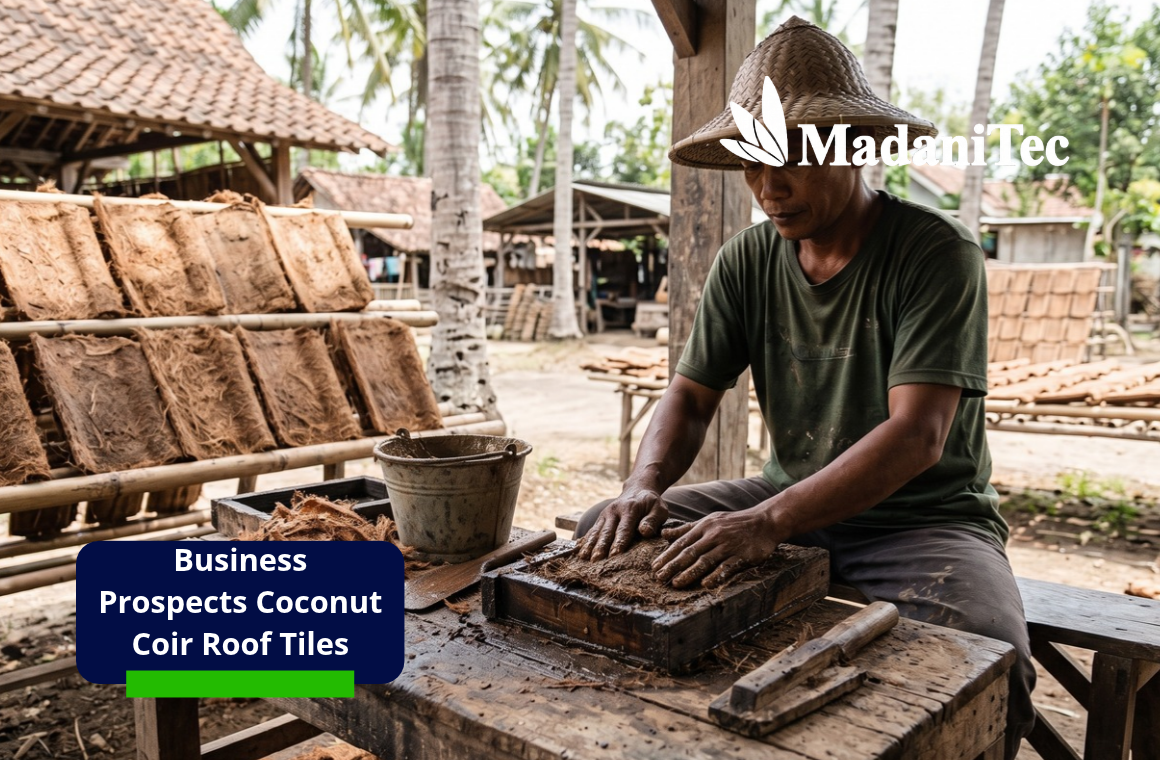
Coconut husks are often left unused or treated as agricultural waste, even though they contain fibers that can be processed into various value-added products. As interest in resource efficiency and sustainable materials grows, exploring new uses for coconut coir can open opportunities for small businesses and entrepreneurs. One idea worth examining is the development of coconut coir roof tiles.
The business prospects for coconut coir roof tiles are linked to a broader opportunity: transforming locally available natural resources into products with potential economic value. However, turning coconut fibers into roofing materials requires more than an innovative idea. Entrepreneurs must also consider production methods, material performance, manufacturing costs, and market demand before investing in this type of business.
Why Is Coconut Husk Waste Worth Exploring as a Business Opportunity?
Coconut husks are generated in large quantities in areas where coconuts are harvested and processed. Without appropriate utilization, some of this material may be discarded or used for low-value purposes.
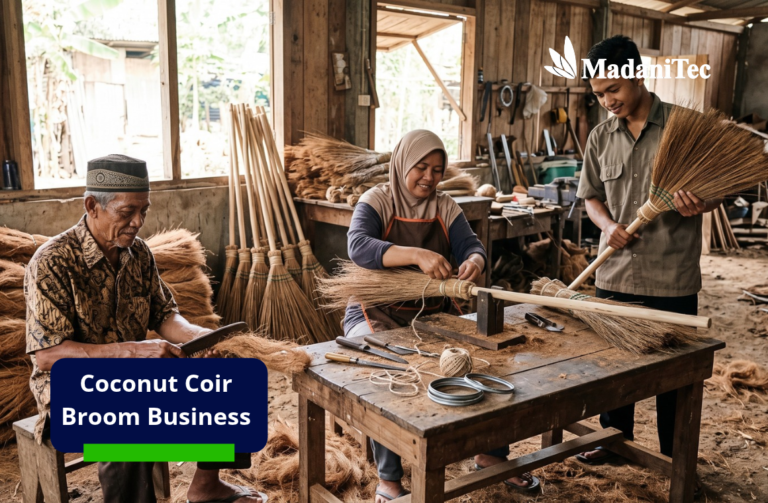
Processing coconut husks into fibers creates opportunities to explore products such as mats, erosion-control materials, ropes, growing media, and other fiber-based applications.
Each product serves a different market, so the most suitable business opportunity depends on local demand, available resources, and processing capabilities.
Learn more about: Can Coconut Husk Become Cocomesh? A Look at the Production Process and Business Potential
The Untapped Value of Coconut Coir
Coconut coir is the natural fiber extracted from coconut husks. Its physical characteristics make it useful in several applications, particularly where fibrous materials are required.
The fibers can be separated, cleaned, graded, and prepared for further processing.
For entrepreneurs, the value lies not only in the raw material but also in the ability to process it consistently.
Reliable fiber quality, efficient production, and appropriate product design can help create a stronger foundation for a value-added business.
Turning Agricultural Waste into Value-Added Products
Agricultural waste utilization can support more efficient resource use by giving discarded materials a potential second purpose.
Instead of relying solely on selling raw coconut husks, businesses can investigate whether processed fibers or finished products offer better commercial opportunities.
However, higher selling prices do not automatically mean higher profits. Processing costs, labor, energy consumption, transportation, and quality control must all be included when evaluating the business model.
How Can Coconut Coir Be Developed into Roofing Materials?
Developing coconut coir into roofing products requires careful material selection and product engineering.
The objective is not simply to compress fibers into a tile shape, but to create a material that can meet the functional requirements of a roof.
Preparing and Processing Coconut Coir Fibers
The initial process may involve collecting coconut husks, extracting the fibers, removing unwanted materials, and drying them under controlled conditions.
The fibers may then need to be cleaned, sorted, or reduced to a suitable size, depending on the intended product design.
Consistent raw materials are important because variations in moisture, fiber length, and contamination can affect manufacturing results.
Entrepreneurs should test different preparation methods before selecting a production process for larger volumes.
The Role of Binders, Molding, and Product Testing
A prototype roofing tile may require a suitable binder or composite formulation to hold the fibers together and maintain its shape. The mixture can then be formed using an appropriate mold and manufacturing process.
The formulation must be developed through testing rather than assumption. A product intended for roofing needs to withstand relevant environmental conditions and meet applicable building requirements.
Water resistance, mechanical strength, dimensional stability, weathering, and fire performance are especially important considerations.
Natural fibers alone should not be assumed to provide adequate protection against rain, heat, or fire.
A coconut coir roofing concept should therefore remain at the research and development stage until its performance has been independently evaluated.
Business Prospects for Coconut Coir Roof Tiles: What Makes Them Interesting?
The business prospects for coconut coir roof tiles depend on whether the product can solve a real customer problem while remaining competitive with established roofing materials.
Its potential appeal comes from combining agricultural by-product utilization with product innovation.
Growing Interest in Sustainable Roofing Materials
Some consumers and businesses are exploring building materials that incorporate renewable resources or recovered materials.
This creates a reason to investigate alternative roofing concepts, particularly where locally available agricultural fibers can be sourced efficiently.
Nevertheless, sustainability claims must be supported by evidence.
The overall environmental impact depends on factors such as the binder used, manufacturing energy, product lifespan, maintenance requirements, and end-of-life disposal or recovery.
Creating New Value from Locally Available Resources
In coconut-producing regions, access to raw husks may offer a starting advantage for entrepreneurs.
Local sourcing could help reduce certain transportation requirements and create opportunities to collaborate with farmers, coconut processors, and small manufacturing businesses.
Potential customers might include specialized building-material suppliers, eco-conscious construction projects, or buyers interested in innovative material concepts.
These are prospective market segments, not guaranteed sources of demand. Interviews with potential buyers, competitor analysis, and prototype trials can help determine whether a viable market exists.
Key Challenges Before Starting a Coconut Coir Roofing Business
An attractive concept is only the beginning. Entrepreneurs must evaluate whether the product can be manufactured consistently, meet safety expectations, and compete on total cost.
Durability, Water Resistance, and Fire Safety
Roofing materials are exposed to rain, sunlight, temperature changes, wind, and other environmental stresses.
A coconut coir-based product must be assessed for water absorption, leakage, structural performance, weather resistance, and long-term durability.
Fire safety is another critical consideration because coconut fibers are organic materials. Any proposed treatment or binder must be assessed as part of the complete product, not assumed to make it fire-resistant.
Testing by a qualified laboratory and compliance with applicable building regulations should guide further development.
Production Costs and Market Validation
Costs may include raw-material preparation, binders, molds, machinery, labor, quality testing, packaging, and distribution.
Small-scale prototypes can help entrepreneurs estimate these expenses before committing to full production.
Market validation is equally important. Comparing the prototype with conventional roofing products can reveal differences in price, weight, installation requirements, maintenance, and expected service life.
If the product cannot demonstrate practical advantages or meet essential performance standards, the business concept may need to be redesigned.
What Equipment May Be Needed to Process Coconut Coir?
Equipment requirements depend on the product design and production scale. Initial processing may involve fiber extraction, cleaning, drying, and size reduction.
A later manufacturing stage may require mixing equipment, molds, pressing systems, or other specialized machinery suited to the selected formulation.
Entrepreneurs should define the production process before purchasing equipment.
Starting with small trials can help identify the required capacity, material characteristics, and workflow, reducing the risk of investing in unsuitable machinery.
For businesses exploring coconut coir processing, Madanitec can be a point of reference when considering appropriate machinery for material-processing operations.
The equipment should be selected according to the actual production requirements, with particular attention to capacity, material compatibility, and operating costs.
The specific machinery needed to manufacture roofing tiles will depend on the formulation and process developed during product testing.
For consultations regarding machines and appropriate technology solutions for various processing and production needs, please contact the Madanitec team via WhatsApp at 081215778768.
Is a Coconut Coir Roofing Business Worth Exploring?
The business prospects for coconut coir roof tiles offer an interesting direction for entrepreneurs looking to explore new uses for agricultural waste.
The idea combines local resource utilization with the possibility of developing a differentiated building material.
Still, commercial success depends on technical validation, reliable production, realistic costing, and evidence of customer demand.
Entrepreneurs should begin with research, prototype development, and appropriate safety testing before moving toward large-scale manufacturing.
With a structured approach to product development and careful equipment planning, coconut coir can be investigated as more than a discarded agricultural by-product.
The first step is to establish whether the proposed roofing material can deliver the performance, safety, and value that the market requires.