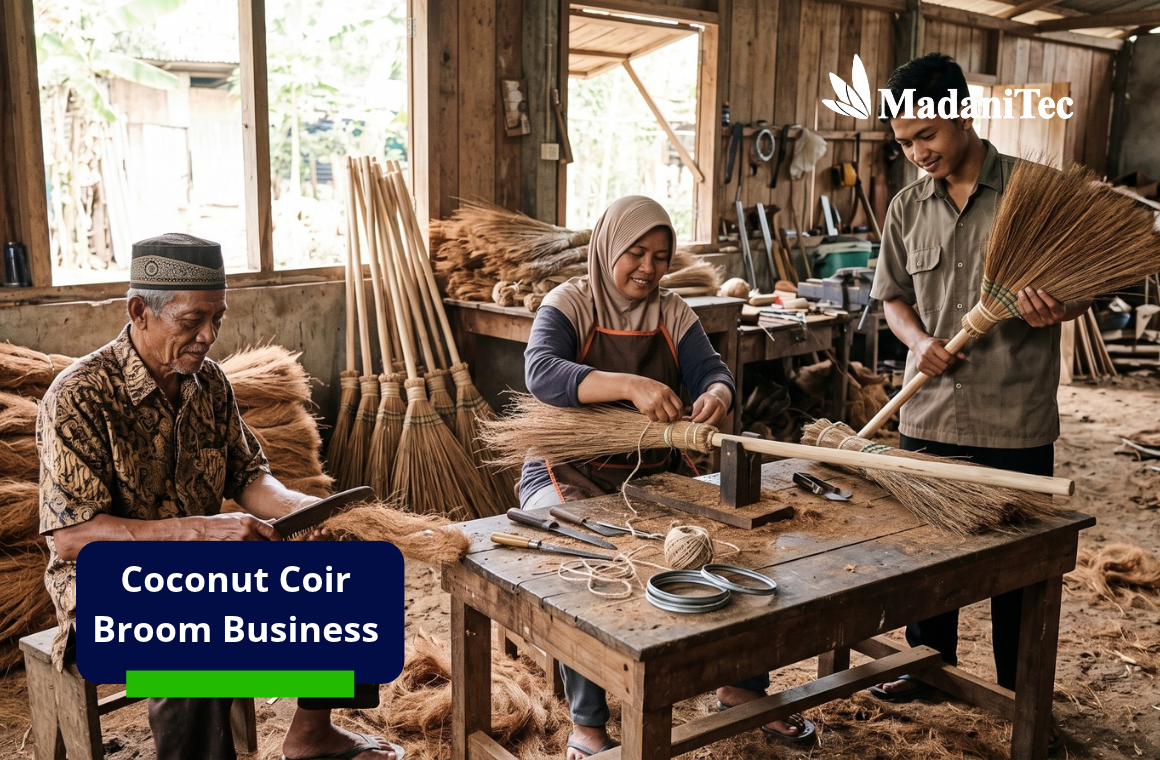
Starting a coconut coir broom business can be an interesting opportunity for small manufacturers looking to turn natural materials into practical household products. Coconut husks, which are often left unused after the fruit is processed, contain fibers that can be used to produce brooms and other useful items.
However, building a successful business involves more than knowing how to make a broom. Entrepreneurs also need to consider raw material quality, production methods, operating costs, and marketing strategies. With careful planning, a small production business can gradually develop a more consistent workflow and reach a wider customer base.
Why Start a Coconut Coir Broom Business?
Coconut coir is a natural fiber obtained from coconut husks. Its relatively coarse texture makes it suitable for products such as traditional brooms, brushes, and other cleaning tools.
One potential advantage of this business is the opportunity to add value to an agricultural by-product.
In areas where coconuts are widely cultivated, entrepreneurs may be able to establish relationships with coconut processors or local suppliers to obtain raw materials.
Demand for practical cleaning tools also creates opportunities to serve different customer groups, including households, traditional markets, cleaning service providers, and retailers.
Nevertheless, business owners should assess local demand, competition, and raw material availability before investing. The commercial potential of coconut coir brooms depends on product quality, pricing, distribution, and customer preferences.
Understanding Coconut Coir as a Raw Material
Raw material quality has a direct influence on the durability and appearance of the finished broom. Therefore, selecting and preparing coconut fibers should be an important part of the production process.
Selecting Suitable Coconut Fibers
Choose fibers that are sufficiently strong, reasonably uniform, and suitable for the intended broom design. The condition of the fibers can vary depending on their source, maturity, storage conditions, and processing methods.
Before purchasing in large quantities, evaluate several samples. Check for excessive moisture, unpleasant odors, contamination, and fibers that break too easily.
Reliable suppliers can help small manufacturers maintain a more consistent supply. It is also useful to compare prices, delivery costs, and the consistency of each supplier’s materials.
Preparing Fibers for Broom Production
Depending on their condition, coconut fibers may require cleaning, drying, separation, and sorting before assembly. Removing unwanted material helps improve the appearance and consistency of the finished product.
Fibers should be stored in a clean, dry, and well-ventilated area to reduce the risk of moisture-related deterioration.
Manufacturers should also establish simple procedures for inspecting incoming materials so that unsuitable fibers are identified before production begins.
Learn more about: Can Coconut Husk Become Cocomesh? A Look at the Production Process and Business Potential
Essential Steps to Start a Coconut Coir Broom Business
A practical business plan helps entrepreneurs organize production and avoid unnecessary expenses during the early stages.
Preparing Tools and Production Equipment
Start by identifying the tools required for each production stage, including fiber preparation, measuring, cutting, tying, handle assembly, and finishing.
The exact equipment will depend on the broom design, expected production volume, and available budget.
For a small operation, it may be reasonable to begin with basic tools and a manageable production target. As customer orders increase, evaluate which activities consume the most time or produce inconsistent results.
Equipment investments should address specific production needs rather than simply increasing the number of machines in the workshop.
Consider operating costs, maintenance requirements, operator safety, and the availability of replacement parts before making a purchase.
Maintaining Product Quality and Consistency
Customers generally expect brooms to perform reliably. Loose fibers, uneven broom heads, weak bindings, and poorly secured handles can reduce product quality and lead to complaints.
Create a simple quality checklist that covers fiber condition, broom size, binding strength, handle stability, and final appearance. Inspect samples regularly and record recurring defects.
Standardizing dimensions and assembly methods can also make production easier to manage. When workers follow the same procedures, manufacturers have a better basis for estimating material requirements, production time, and product costs.
Calculating Production Costs and Pricing
Before setting a selling price, calculate the main expenses involved in making each broom. These may include raw materials, handles, binding materials, labor, electricity, packaging, transportation, and equipment maintenance.
Divide the total production cost by the number of acceptable finished products to estimate the cost per broom. Remember to account for material waste and products that do not pass quality inspection.
Next, compare the estimated cost with competitor prices and the amount customers are willing to pay. The selling price should cover operating expenses while leaving a reasonable margin for the business.
Rather than competing on price alone, small manufacturers can differentiate their products through consistent quality, suitable packaging, reliable delivery, or product variations designed for specific customers.
How to Market Coconut Coir Brooms Effectively
An effective marketing strategy begins with identifying the right customers. Local retailers, household supply stores, traditional markets, cleaning service providers, and wholesale distributors may represent potential sales channels.
Entrepreneurs can start by offering samples to prospective buyers and collecting feedback on durability, appearance, pricing, and preferred product sizes. This information can guide product improvements before production expands.
Digital marketing can also help businesses reach customers beyond their immediate area. Clear product photographs, accurate descriptions, wholesale information, and responsive communication can strengthen buyer confidence.
For business-to-business sales, prepare a simple product catalog containing specifications, minimum order quantities, packaging details, and delivery arrangements.
Consistent service can be just as important as the product itself when building long-term relationships with retailers and distributors.
Common Challenges in Coconut Coir Broom Production
Small manufacturers may face several challenges as their businesses develop. Raw material prices can fluctuate, while inconsistent fiber quality may affect production results. Manual assembly can also limit output when orders increase.
These challenges can be managed through practical planning. Maintain relationships with multiple suppliers where possible, inspect materials before use, and monitor inventory to reduce the risk of unexpected shortages.
It is also important to track production time and waste. Records can reveal which stages create bottlenecks and whether changes to work arrangements, tools, or equipment would be worthwhile.
Expanding too quickly can put pressure on cash flow. A gradual approach—supported by confirmed demand, realistic cost calculations, and quality control—can help manufacturers manage growth more sustainably.
Learn more aboutL: From Coconut Waste to Roofing Innovation: The Business Potential of Coir Roof Tiles
Supporting Business Growth with Better Processing Methods
As a coconut coir broom business grows, improving the way raw materials are handled and prepared may help make production more organized.
The appropriate solution depends on the type of fiber, the existing workflow, and the volume of materials processed each day.
Before investing in equipment, identify the task that needs improvement. Consider whether the main challenge is material preparation, handling, storage, or another stage of production.
Compare available solutions based on their suitability, operating requirements, maintenance needs, and overall cost.
Madanitec supports business development through appropriate-technology machinery and processing solutions for different small and medium-sized business needs.
Entrepreneurs exploring ways to improve their production operations can consider the processing requirements of their own business before choosing suitable equipment.
The goal is not simply to add machinery, but to develop a production process that matches the business’s actual needs and growth plans.
For consultations regarding machines and appropriate technology solutions for various processing and production needs, please contact the Madanitec team via WhatsApp at 081215778768.
Conclusion: Building a Sustainable Coconut Coir Broom Business
Starting a coconut coir broom business requires careful planning, from selecting suitable raw materials to maintaining product quality, calculating costs, and finding reliable customers.
Although the business can offer an opportunity to add value to coconut husks, long-term performance depends on market demand, production efficiency, and sound financial management.
Small manufacturers can begin with a manageable production scale, learn from customer feedback, and improve their processes as demand develops.
By combining consistent quality with practical business decisions and appropriate processing solutions, entrepreneurs can build a stronger foundation for future growth.