Converting plastic waste to fuel is attracting increasing attention as a potential method for deriving value from specific plastic waste streams. Rather than simply burning plastic, controlled technologies such as pyrolysis can thermally decompose it into products including pyrolysis oil, gas, and solid residue.
But can plastic waste truly be converted into fuel? The answer is yes, through controlled thermal processes like pyrolysis. However, pyrolysis cannot be equated with the simple burning of plastic; the two processes are fundamentally different.
What Does Plastic Waste Turn Into When It Is Burned?
Burning plastic waste in the open does not automatically produce fuel.
Combustion generates heat and various by-products, while incomplete combustion can release particles and air pollutants that are harmful to health.
The WHO emphasizes that open waste burning produces various air pollutants and can increase the risk of health problems, including respiratory issues.
Therefore, burning plastic indiscriminately is not a suitable method for converting waste into fuel.
What is the difference between combustion and pyrolysis?
The main difference lies in the process conditions. Combustion occurs in the presence of oxygen and aims to generate heat, whereas pyrolysis involves heating a material without an external oxygen supply to break down its chemical structure.
The EPA notes that the plastic pyrolysis process generally yields three groups of products: pyrolysis oil, hydrocarbon gases, and solid residue or char.
What Happens When Waste Is Burned?
When waste is burned, the materials within it undergo chemical reactions at high temperatures.
The challenge lies in the fact that household waste typically consists of a wide variety of materials—ranging from plastics, paper, and fabrics to organic matter. This lack of compositional uniformity means that the products of combustion can vary.
Open burning is a cause for concern because its emissions can pollute the air. The WHO identifies this practice as a source of air pollution that impacts both health and the environment.
Therefore, waste management requires appropriate technology and process controls, rather than simply disposing of waste through open burning.
Read more about: Indonesia’s Waste Management Crisis: Landfills Are Filling Up—Where Will the Waste Go?
Why Can Plastic Be Turned into Fuel?
Converting plastic waste to fuel is possible because many types of plastic consist of hydrocarbon chains derived from petrochemical feedstocks. When heated under pyrolysis conditions, these polymer chains can break down into smaller hydrocarbon molecules.
What Is Plastic Pyrolysis?
Pyrolysis is the process of the thermal decomposition of materials in the absence of an external oxygen supply. In the process of converting plastic waste to fuel, controlled heating can yield liquid, gaseous, and solid fractions.
Research on plastic waste pyrolysis indicates that the type of plastic, temperature, vapor residence time, reactor type, catalyst, and operating conditions can influence the quantity and characteristics of the resulting products.
How Is Plastic Converted into Oil?
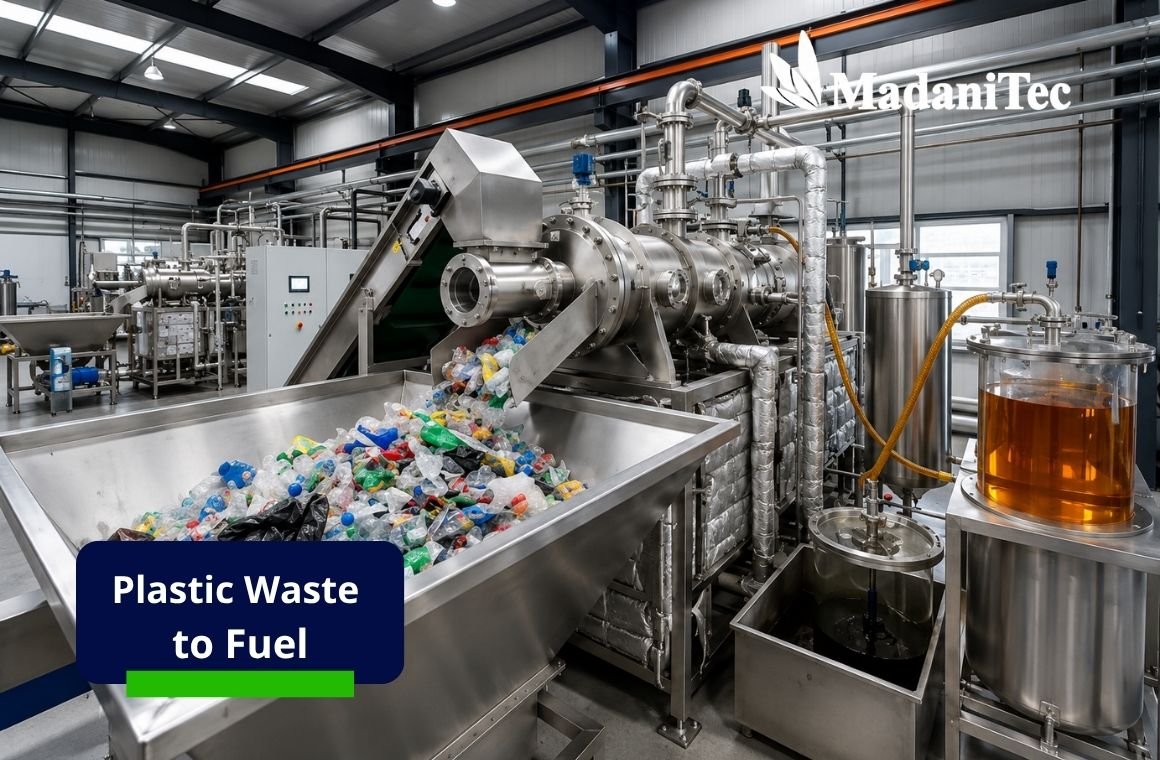
Simply put, the plastic is first prepared and heated in a reactor. The polymer chains then break down, producing hydrocarbon vapors.
These vapors can be cooled and condensed to produce pyrolysis oil.
UNEP explains that plastic pyrolysis can yield oil, gas, and solid carbon.
The oil produced through this process has the potential to be used in certain energy applications, although its use depends on the characteristics and quality of the resulting product.
Is Fuel Made from Plastic Waste Safe?
This question cannot be answered simply with “safe” or “unsafe.” Pyrolysis oil is not automatically equivalent to ready-to-use commercial fuel.
Its quality is influenced by the type of plastic, processing conditions, feedstock contamination, and the stages of purification or upgrading following the pyrolysis process.
The type of plastic plays a crucial role. Scientific literature indicates that plastics such as PE, PP, and PS can yield hydrocarbon products through pyrolysis, whereas PVC presents specific challenges; its chlorine content can generate corrosive compounds and affect product quality.
Therefore, the characteristics of pyrolysis oil must be tested before it is used for specific applications.
Research on plastic pyrolysis oil also shows that fuel characteristics and emissions can vary depending on the type of plastic and the formulation used.
Can All Types of Plastic Be Processed into Fuel?
Not all plastics share the same characteristics. PE, PP, and PS are among the types frequently studied for hydrocarbon production via pyrolysis.
Meanwhile, PVC and PET require special attention, as they can pose challenges regarding both the processing method and the quality of the resulting product.
This means that the success of the processing operation depends on more than just the machinery. Feedstock sorting, reactor design, temperature, processing time, condensation, and product testing are all vital components of the processing system.
Read more about: Types of Plastic Waste That Can Be Recycled, Here They Are!
Plastic Waste to Fuel: From Waste to Energy
Overall, processing plastic waste to fuel through controlled pyrolysis can be a pathway to derive added value from specific plastic waste streams.
Converting plastic waste into fuel does not simply mean burning plastic indiscriminately.
Technologies like pyrolysis operate on a different principle: altering the polymer structure through a controlled thermal process to produce materials that can be further utilized.
With this approach, plastic waste that is difficult to manage via conventional methods has the potential to be viewed not merely as an environmental burden, but also as a source of raw materials for material and energy recovery.
Madanitec — providing technology and machinery solutions to support waste processing and the development of circular economy-based businesses, Indonesia’s waste issues.
Affordable prices and reliable quality are supported by after sales service and warranty with every purchase. Do not hesitate to contact 081215778768 via WhatsApp and get a special offer today.