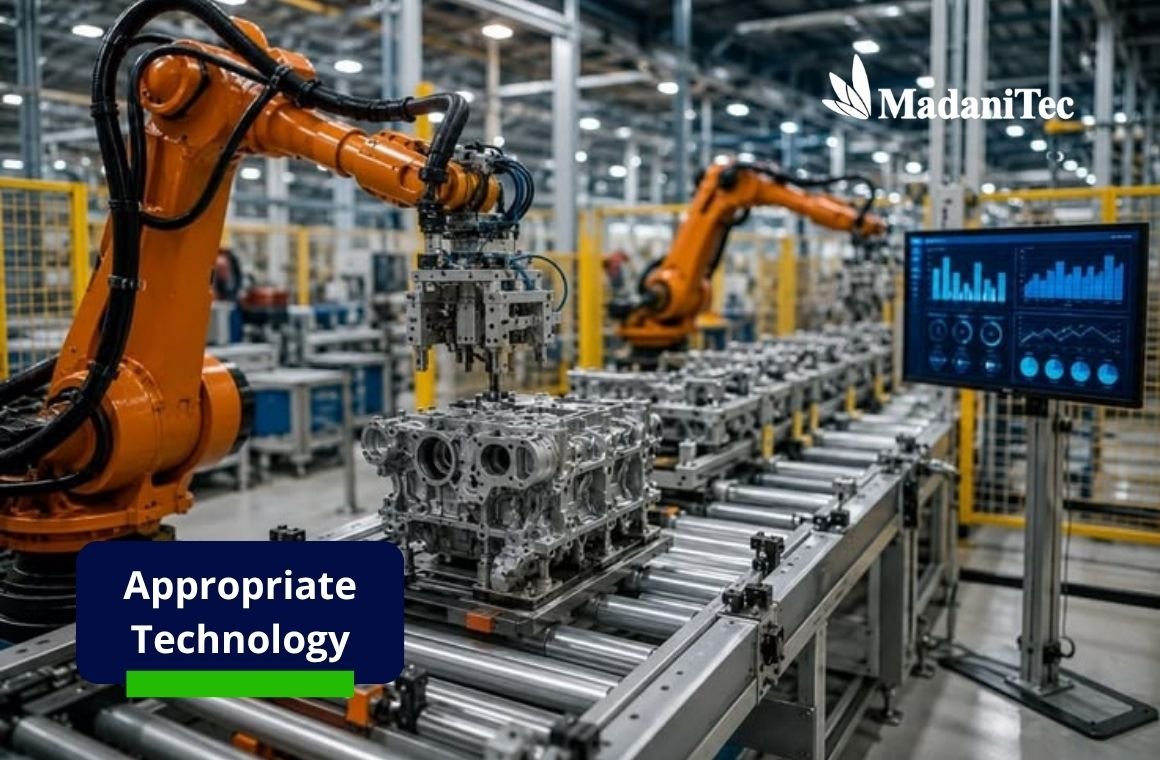
Appropriate technology is not always the most advanced or automated solution. The right technology is one that fits the production process, material, capacity, workforce, and actual needs of a business.
For small businesses, SMEs, and growing industries, choosing appropriate technology can help improve productivity, reduce manual work, and solve specific production problems without unnecessary complexity or investment.
What Is Appropriate Technology?
Appropriate technology refers to technology that is selected according to the actual needs and conditions of its users.
It does not necessarily mean using the simplest or cheapest technology available. Instead, the focus is on finding a solution that provides practical benefits without creating unnecessary complexity.
For a small or medium-sized business, for example, a machine with a moderate capacity may be more suitable than a highly automated system designed for large-scale production.
If the machine can handle the required materials, improve productivity, maintain product consistency, and remain manageable for the available workforce, it may already provide the right technological solution.
This principle is particularly relevant to businesses looking for technology for small businesses or machinery for small-scale industries.
A production machine should support the way a business actually operates rather than forcing the business to adopt technology that is unnecessarily complicated.
Therefore, appropriate technology is less about how advanced a machine looks and more about how effectively it solves a real production need.
Why the Most Advanced Technology Is Not Always the Right Choice
Advanced technology can provide significant benefits, particularly for businesses with high production volumes, complex processes, or strong automation requirements. However, those advantages can come with additional considerations.
A more sophisticated machine may require a larger initial investment, specialized operators, more complex maintenance, or supporting infrastructure.
Some systems may also require specific electrical capacity, software, spare parts, or technical support.
If those features are not actually needed, the additional complexity may not provide proportional benefits.
This does not mean that advanced technology is unsuitable. The important question is whether its capabilities match the business requirements.
For example, a growing food producer may need a machine that improves a specific processing stage rather than an entirely automated production line.
A material-processing business may benefit more from the right cutting, grinding, shredding, or pressing equipment than from a highly integrated system with functions it does not currently use.
This is where choosing the right machine becomes more important than simply choosing the newest machine.
Learn more about: Why Great Solutions Often Start With Ordinary Problems
What Should Businesses Consider Before Choosing Production Technology?
Choosing production technology requires looking beyond specifications. Several practical factors should be considered before making an investment.
Production Capacity
The machine’s capacity should correspond to the actual production volume and the business’s growth target.
Choosing equipment that is too small can create bottlenecks when demand increases. On the other hand, investing in a machine with capacity far beyond current requirements can leave much of its potential unused.
For businesses evaluating production machines, capacity should therefore be discussed together with the current workload, expected growth, available workforce, and production targets.
Material and Processing Requirements
Different materials require different processing approaches. Characteristics such as hardness, moisture content, size, texture, thickness, and flexibility can influence the type of technology required.
This is particularly important when selecting machines for material processing.
Cutting equipment, shredders, grinders, milling machines, presses, and extractors can serve very different purposes depending on the material and desired output.
Madanitec’s range of production machinery reflects this practical approach: the machine selection should begin with understanding what material needs to be processed and what result the business needs to achieve.
A machine designed for one material may not automatically produce the same results with another.
Understanding the material and desired output should therefore come before choosing the machine.
Operating and Maintenance Requirements
Technology also needs to be practical for the people who will operate it.
Businesses should consider operator skills, electricity or fuel requirements, maintenance procedures, availability of spare parts, production space, and technical support.
A machine that performs well but is difficult to operate or maintain may create problems in daily production.
For SMEs and small industries, these practical considerations can be just as important as the machine’s headline specifications.
How Can Simple Machines Become Appropriate Technology?
Appropriate technology does not have to involve sophisticated automation. A relatively simple machine can create significant value when it addresses a repetitive or inefficient production task.
For example, a cutting machine can help reduce repetitive manual cutting. A milling or grinding machine can simplify size reduction.
A shredder or chopper can process materials into a more manageable form, while a press or extractor can help separate or process materials more efficiently.
These types of machines are also relevant to the kind of production solutions offered by Madanitec.
Rather than treating technology as a collection of advanced features, the focus can be placed on which part of the production process needs improvement.
A food business may need more consistent processing. A material-processing business may need better size reduction.
Another producer may need to make pressing or extraction more practical. In each situation, the appropriate machine can be different.
The important factor is not the number of features a machine has, but the production problem it solves.
For small and growing businesses, this approach can make technology investment more focused.
Instead of replacing an entire production system, a business can identify one process that consumes excessive time or labor and introduce technology specifically where it can provide measurable value.
When Should a Business Choose More Advanced Technology?
There are situations where more advanced technology can be the appropriate choice.
Businesses handling large production volumes may benefit from automation because manual processes can become difficult to manage at scale.
More sophisticated systems may also be useful when production requires precise control, continuous monitoring, complex processing, or consistent output across large quantities.
The decision should therefore be based on the relationship between the technology’s capabilities and the business’s actual requirements.
As production grows, technology can also evolve. A business may begin with a relatively simple machine and gradually move toward greater automation when production volume, workforce requirements, or process complexity make that investment worthwhile.
This creates an important principle for technology selection: the appropriate technology can change as the business changes.
A machine that is suitable for an emerging business today may eventually need to be complemented or replaced by higher-capacity equipment as production expands.
The Right Technology Starts With the Right Problem
One of the most useful ways to approach technology selection is to reverse the usual question.
Instead of asking, “What is the most advanced machine available?”, businesses can start with:
“What production problem am I trying to solve?”
From there, the decision can follow a more logical sequence:
Problem → Need → Material → Capacity → Technology → Machine
This approach helps businesses avoid choosing technology simply because it has more features. It also makes the investment easier to connect with measurable production objectives.
For example, a business considering a grinding machine should first understand the material, required particle size, expected production capacity, and operating conditions.
Someone looking for a shredder needs to consider the material characteristics and desired output.
A business requiring pressing or extraction equipment needs to understand the process and production target.
These considerations are the foundation of a practical appropriate technology approach.
For businesses that are still evaluating their options, Madanitec can be a useful starting point for discussing production machinery based on the actual process involved.
As a manufacturer and supplier of various production machines, Madanitec can help businesses explore equipment options according to material characteristics, production capacity, and the intended application.
The objective is not simply to find a machine with the most features, but to find a machine that makes sense for the production process.
Learn more about: Small Machines, Bigger Opportunities: How Production Technology Supports Growing Businesses
Conclusion: Choose What Fits, Not Just What Looks Advanced
The most advanced technology is not automatically the most appropriate technology. Its value depends on how well it fits the production process, material, capacity, workforce, infrastructure, and long-term business needs.
For small businesses and growing industries, the right technology may sometimes be a relatively simple machine that solves a specific production problem effectively.
In other situations, higher levels of automation and more advanced systems may be justified by increasing production demands.
For this reason, businesses should evaluate technology based on fit, function, and practical value rather than technological complexity alone.
If you are exploring production machinery for a specific material or process, Madanitec can help you look at the available machine options based on your actual production needs.
Discussing the process, capacity, material, and expected output first can make the technology investment more focused and useful.
Ultimately, choosing technology should not begin with the question of how advanced a machine is. It should begin with understanding what the business actually needs.
When technology is selected based on real production requirements, investment can become more focused, practical, and useful for sustainable business growth.
The appropriate solution can be considered based on waste type, processing capacity, and operational requirements.
For consultation regarding waste processing machinery and suitable capacity, contact the Madanitec team via WhatsApp at 081215778768.