For many small businesses, production often begins with simple tools, limited equipment, and manual labor. This approach can work well when production volumes are still manageable.
But as orders increase, repetitive tasks can take more time, production capacity can become difficult to expand, and maintaining consistent results can become a bigger challenge.
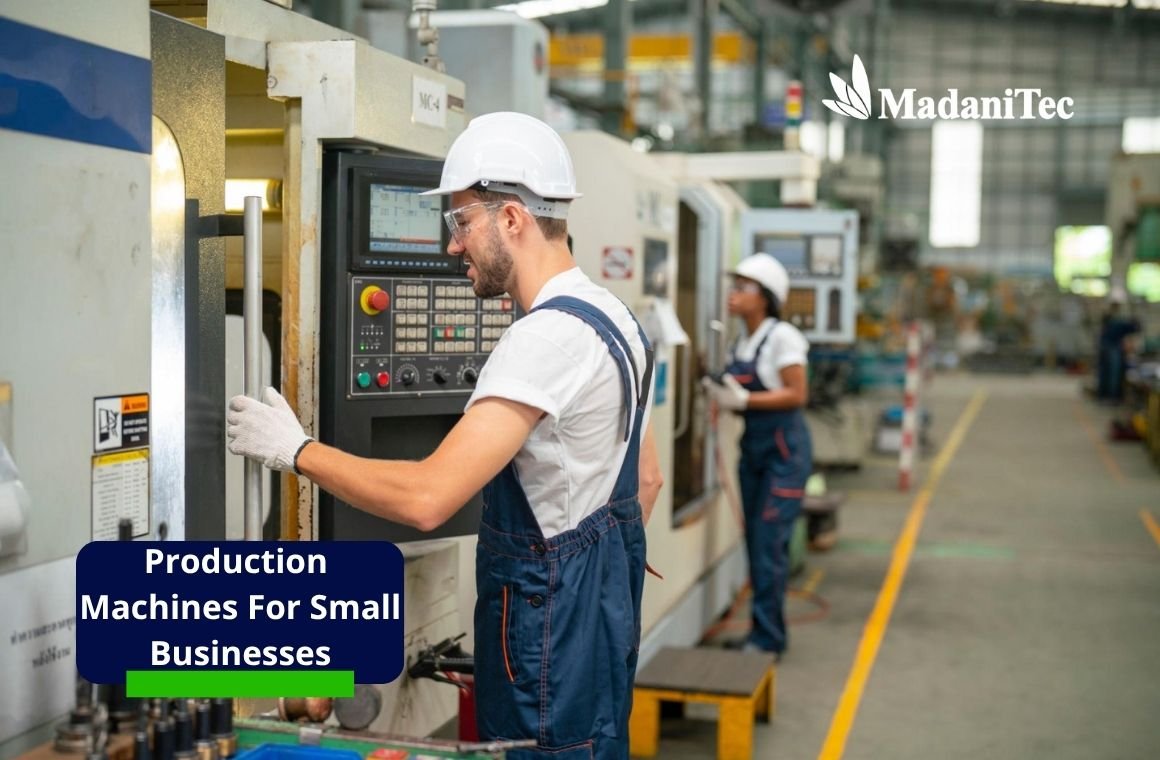
This is where production machines for small businesses can make a practical difference. Modern production technology does not always mean large industrial systems, robotics, or highly automated factories.
For a growing business, it can simply mean using the right machine to make one important production process faster, more consistent, and easier to manage.
Why Are Small Businesses Turning to Production Machines?
Growth changes the way a business looks at production.
When demand is low, doing everything manually may be reasonable. But when the same cutting, grinding, crushing, pressing, or processing task has to be repeated dozens or hundreds of times, the limitations of manual work become more visible.
This is particularly relevant because productivity tends to increase with firm size, while manufacturing shows a strong relationship between scale and productivity.
OECD data for 2024 found that SMEs generally had lower labour productivity than large firms, with the gap especially pronounced in manufacturing.
For small businesses, this does not mean they need to become large factories overnight. Instead, it highlights the importance of improving the production process as the business grows.
Technology can become one part of that improvement.
The Indonesian Ministry of Industry has also emphasized the use of appropriate technology for small and medium industries (IKM), including technology for production, management, and marketing to improve capacity and quality.
How Production Machines Help Small Businesses Grow
Increasing Production Capacity
One of the most obvious reasons to introduce a machine is to make repetitive production processes more efficient.
Consider a business that needs to cut ingredients, grind raw materials, reduce material size, or process large quantities of a particular input.
Performing every stage manually can consume considerable time and energy.
A suitable machine can take over part of that repetitive process, allowing production to handle a larger workload within the same operating period.
Kementerian Perindustrian reported that its 2023 machinery and equipment restructuring program for IKM participants was associated with a reported 103% increase in production capacity based on monitoring and evaluation.
This figure applies specifically to the participating businesses in that program, rather than representing a universal increase for every business using machinery.
Improving Product Consistency
Production capacity is not the only consideration.
For many businesses, consistency is equally important. Customers expect products to have similar characteristics from one purchase to another.
Machines can help standardize certain repetitive processes, such as cutting, grinding, crushing, or processing materials to a particular size.
This does not eliminate the need for human control. Instead, the machine becomes a tool that helps operators perform repetitive processes more consistently.
Reducing Repetitive Manual Work
Another important benefit is reducing the amount of repetitive physical work required from workers.
This does not necessarily mean replacing people with machines. A more practical approach for small businesses is to allow people to focus on tasks that require supervision, quality control, preparation, packaging, and decision-making while machines assist with repetitive production stages.
In this sense, technology becomes a way to improve how people work rather than simply replacing them.
Learn more about: How Technology Is Changing the Way Small Industries Produce and Grow
What Production Machines for Small Businesses Can Support Business Growth?What Types of Production Machines Can Support Small Businesses?
The right machine depends on the type of business and the production process involved. There is no single machine that is suitable for every entrepreneur.
Food Processing Machines
Food businesses may need machines for cutting, grinding, extracting, mixing, or processing ingredients.
For example, a cutting machine can help prepare ingredients more consistently, while a milling or grinding machine can process raw materials into smaller particles or flour-like products.
These machines can be useful when a business needs to move beyond small manual batches.
Material Processing and Cutting Machines
Some businesses work with materials that need to be cut, chopped, or processed before they can become finished products.
Machines for cutting and material processing can help prepare raw materials more efficiently and make the next production stage easier to manage.
For businesses that handle increasing volumes, this can become an important step toward a more structured production workflow.
Grinding, Crushing, and Size-Reduction Machines
Grinding, crushing, and size reduction are also common stages in many production processes.
A material may need to be reduced in size before it can be processed further, mixed with another material, or converted into a final product.
This means a machine does not always need to produce the final product itself. Sometimes its value comes from improving one important stage within the overall production chain.
Do Small Businesses Really Need Advanced Production Technology?
Not necessarily.
The goal should not be to purchase the biggest or most sophisticated machine available. The more important question is whether a machine solves a real production problem.
Before investing, entrepreneurs can consider several factors: production volume, frequency of repetitive work, available space, operating costs, product requirements, and future business plans.
A small business may only need a machine for one specific production stage. As demand grows, additional equipment can be introduced gradually.
This approach is consistent with the concept of appropriate technology, which Kementerian Perindustrian describes as technology designed to meet IKM needs with practical, reliable, and relatively affordable solutions.
How the Right Machine Can Open New Business Opportunities
The biggest opportunity may not always be producing the same product faster.
Better production capability can also give entrepreneurs room to explore new products, larger orders, or different market segments.
For example, a machine that processes a particular type of raw material may allow a business to experiment with different product variations.
A machine that improves preparation or processing can also make it easier to handle orders that were previously too time-consuming to accept.
This creates an important shift in perspective.
Instead of asking only, “How can I produce more?”, entrepreneurs can begin asking, “What else can I produce with the capability I now have?”
That is where a relatively small machine can contribute to a much bigger business opportunity.
Learn more about: Can Technology Help Industries Reduce Waste Without Slowing Production?
Conclusion: Bigger Opportunities Can Start With Small Machines
Technology in production does not always have to look like a large automated factory. For small and growing businesses, meaningful improvements can begin with something much simpler: finding the right machine for the right production problem.
A suitable machine can help reduce repetitive work, improve consistency, increase production capacity, and give entrepreneurs more room to develop their products.
Ultimately, the value of a production machine is not determined only by its size or technical features. Its real value comes from how well it supports the needs and direction of the business.
For entrepreneurs looking to improve their production process, choosing the right technology can therefore be an important step toward turning small machines into bigger opportunities.
Madanitec provides technology and machinery solutions for businesses looking to improve waste processing and material handling.
The appropriate solution can be considered based on waste type, processing capacity, and operational requirements.
For consultation regarding waste processing machinery and suitable capacity, contact the Madanitec team via WhatsApp at 081215778768.