The growing demand for alternative fuels has created promising opportunities for businesses producing wood charcoal briquettes. Made from processed wood residues and biomass materials, these compact fuel products can serve international markets when they meet the quality, packaging, and supply requirements expected by overseas buyers.
For beginners, understanding how to export wood charcoal briquettes is not simply about finding customers in other countries. A successful export business also requires consistent production, suitable equipment, reliable quality control, proper packaging, and the ability to fulfill orders according to buyer specifications.
That is why export preparation should begin from the production stage.
What Are Wood Charcoal Briquettes?
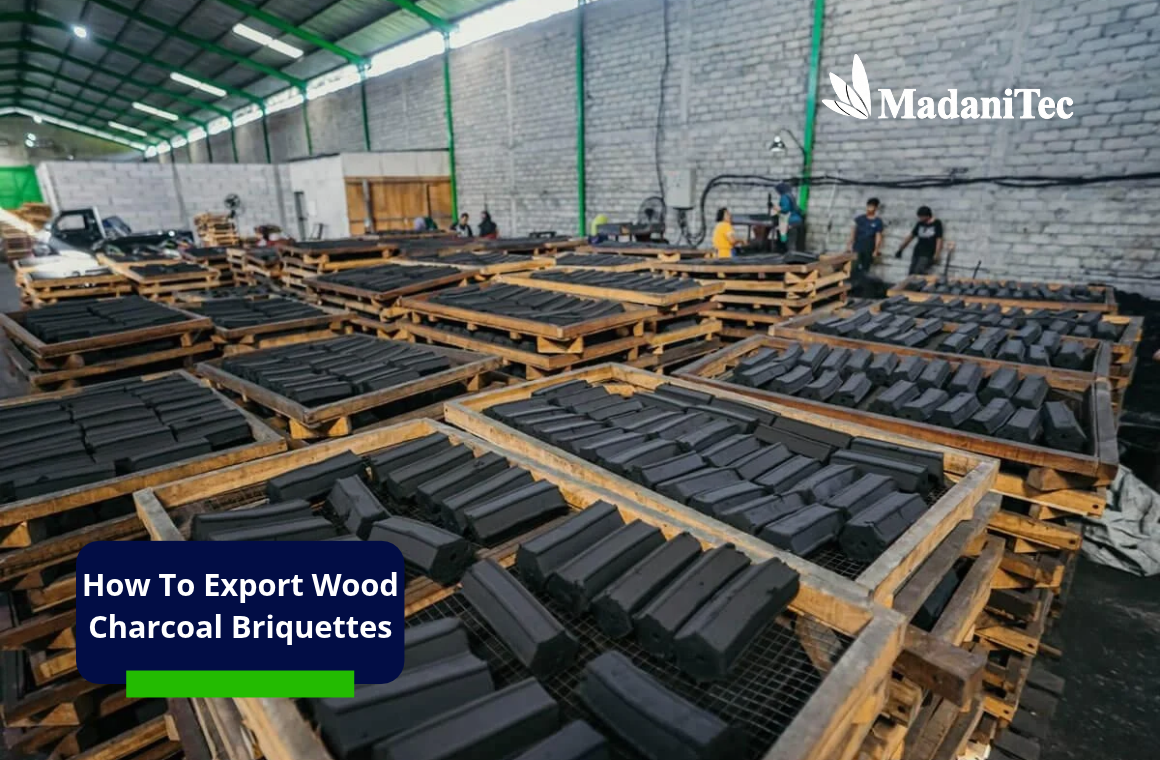
Wood charcoal briquettes are solid fuel products made by processing charcoal from wood or wood residues into a compact and uniform form.
The production process generally involves carbonizing the raw material, crushing the resulting charcoal, mixing it with a suitable binder, pressing the mixture into a specific shape, and drying the finished briquettes.
Compared with loose charcoal, briquettes can provide more uniform shapes and make handling, packaging, storage, and transportation more practical.
For export-oriented businesses, consistency is particularly important. Buyers may require specific dimensions, moisture levels, density, packaging quantities, and other product characteristics.
Learn more about: 7 Ways to Process Sawdust into Valuable Products and Business Opportunities
What Is the Process of Making Wood Charcoal Briquettes?
Understanding the production process helps businesses prepare products that are more suitable for international orders.
1. Preparing Wood Waste or Biomass
Production starts with selecting suitable raw materials, such as sawdust, wood residues, or other appropriate biomass materials.
Large wood residues may need to be reduced in size before further processing. A consistent raw material supply can also help maintain stable production quality.
2. Carbonizing the Wood Material
The prepared material is converted into charcoal through carbonization.
This stage has an important influence on the characteristics of the charcoal used for briquette production. Consistent processing conditions can help producers maintain more predictable raw material quality.
3. Crushing and Grinding the Charcoal
After carbonization, the charcoal is crushed or ground into smaller particles.
Uniform particle size can make mixing and forming easier to control. For businesses preparing larger quantities, appropriate size-reduction equipment can also reduce reliance on manual processing.
4. Mixing Charcoal With Binder
The charcoal powder is then mixed with a suitable binder.
The mixture needs to be sufficiently uniform so that the material can be pressed consistently. An uneven mixture may affect the strength, shape, and overall quality of the finished briquettes.
5. Briquette Forming and Pressing
The prepared mixture is compressed using a briquette press.
This stage determines the shape, dimensions, and density of the briquettes. Consistent forming becomes increasingly important when a producer needs to fulfill large or recurring export orders.
6. Drying the Briquettes
Freshly pressed briquettes need to be dried before packaging.
Proper drying helps reduce moisture and improves stability during storage and transportation. The drying method should be selected according to the production scale and product requirements.
7. Quality Control
Quality control should be performed throughout the production process.
Producers can monitor factors such as moisture content, dimensions, density, strength, appearance, and consistency. Maintaining stable specifications can help build confidence among international buyers.
What Machines Are Needed to Produce Wood Charcoal Briquettes?
The equipment required depends on the raw material, production capacity, and processing system.
A Wood Chipper for Biomass can be useful at the upstream stage when larger wood residues need to be reduced in size.
However, it is important to understand that a wood chipper is not a briquette-making machine. Its role is primarily to prepare larger biomass materials for subsequent processing.
A complete briquette production system may also involve carbonization equipment, charcoal crushers or grinders, mixing equipment, briquette presses, drying equipment, and packaging equipment.
Rather than selecting machines based only on their capacity, businesses should consider the entire production flow.
Raw material characteristics, target output, available workspace, energy requirements, labor, and future expansion should all be considered.
How to Export Wood Charcoal Briquettes Successfully?
Once production is prepared, businesses need to connect product quality with export requirements.
The first step is to determine the specifications of the briquettes being offered. These may include dimensions, moisture content, density, packaging quantity, and other characteristics requested by buyers.
Packaging is another important consideration. Briquettes need packaging that can protect the product during handling, storage, and long-distance transportation.
Exporters should also understand the documentation and procedures applicable to their shipment.
Requirements can vary depending on the destination country, product classification, buyer, and shipping arrangement. Current requirements should therefore be verified before completing an export transaction.
Finally, producers need to understand their target buyers. Different international buyers may have different expectations regarding product quality, packaging, order quantities, delivery schedules, and specifications.
Why Production Consistency Matters for Export
International buyers generally expect suppliers to deliver products according to agreed specifications.
This can become challenging when production relies heavily on manual processes. Differences in raw material preparation, mixing, pressing, or drying may result in variations between batches.
For example, if one shipment has significantly different moisture levels or dimensions from a previous order, the buyer may question the consistency of the supplier.
A more controlled production system can help businesses maintain stable output and prepare for repeat orders. This is particularly valuable when moving from small-scale production toward larger export contracts.
How Much Production Capacity Do You Need for Export?
There is no universal production capacity for every export business.
A small producer may begin with limited orders, while an established manufacturer may need considerably larger output to fulfill recurring international shipments.
The important factor is to calculate realistic production capacity based on working hours, equipment performance, drying time, labor, maintenance, and expected order volume.
Businesses should also identify potential bottlenecks. If the pressing stage can produce more material than the drying stage can handle, for example, the overall production capacity will still be limited.
Common Production Problems When Scaling a Briquette Business
Several problems can appear when a small briquette business begins accepting larger orders.
These may include inconsistent raw materials, insufficient equipment capacity, uneven mixing, variations in briquette dimensions, high moisture content, and excessive dependence on manual labor.
Another common mistake is purchasing equipment without first understanding the actual production requirements.
A better approach is to identify the specific bottleneck and select equipment that addresses that problem while supporting the overall production workflow.
Choosing the Right Equipment for Your Briquette Business
Choosing equipment should be based on the complete production process rather than on machine capacity alone.
Consider the type of raw material, required processing stages, target production volume, available space, energy requirements, labor, maintenance, and future business development.
For businesses planning to export, equipment should also support consistent production. Stable output makes it easier to maintain product specifications and fulfill larger orders.
Madanitec can be considered as a technology partner for businesses developing biomass and material-processing operations.
The appropriate solution can be evaluated according to raw material characteristics, processing requirements, production capacity, and business goals.
Conclusion
Understanding how to export wood charcoal briquettes begins with building a reliable production system.
Finding international buyers is only one part of the process. Producers also need consistent raw materials, controlled processing, suitable equipment, quality control, proper packaging, and the ability to fulfill orders according to agreed specifications.
As the business grows, improving production efficiency can become an important step toward handling larger and more consistent export orders.
For businesses that need support in developing biomass or material-processing operations, Madanitec can help evaluate appropriate technology solutions based on the production process and business requirements.
Instead of choosing equipment simply because it has a large capacity, selecting a solution that fits the entire workflow can provide a stronger foundation for long-term business growth.
For consultations regarding machines and appropriate technology solutions for various processing and production needs, please contact the Madanitec team via WhatsApp at 081215778768.