Coconut husks are often considered agricultural waste after the fruit has been used for food, beverages, or other purposes. However, these natural materials can be processed into valuable products, including cocomesh, a mesh made from coconut coir fibers. This product has practical applications in soil protection, erosion control, and environmental restoration.
For entrepreneurs and small businesses, cocomesh from coconut husk offers an opportunity to explore value-added products made from locally available resources. Understanding how cocomesh is produced, what equipment may be required, and where the product can be used is an important first step before developing a business around it.
1. What Is Cocomesh Made from Coconut Husk?
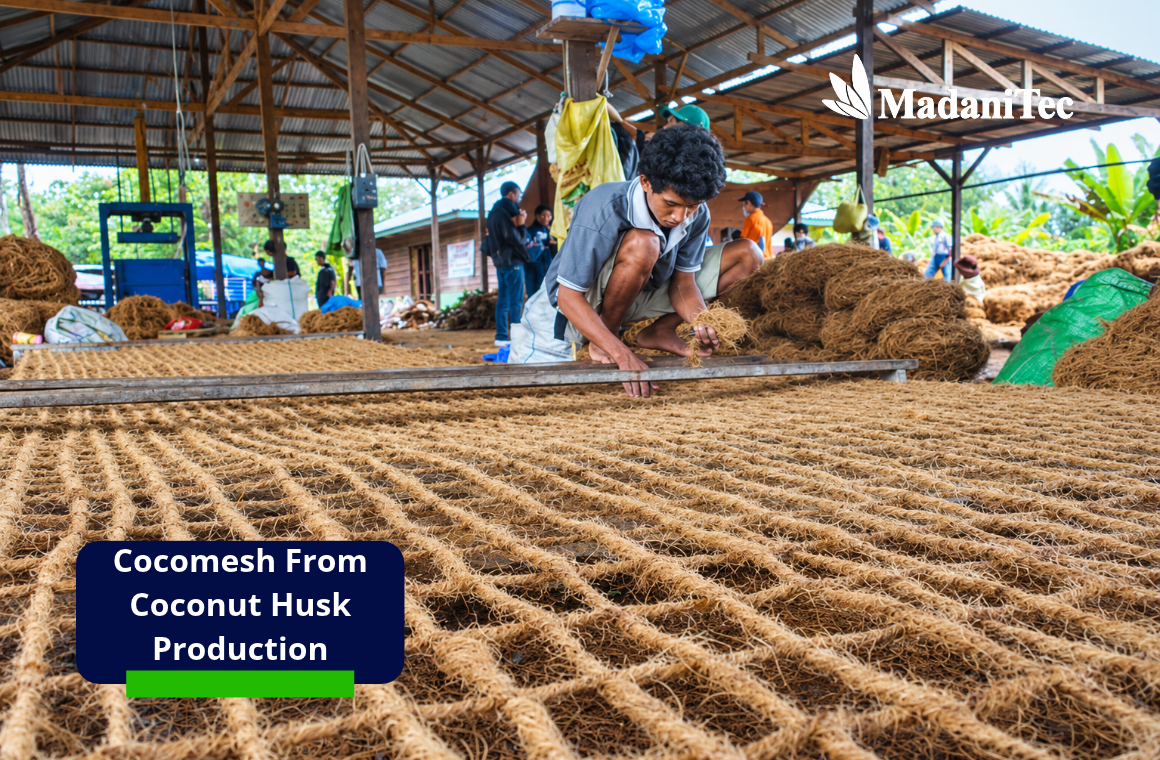
Cocomesh is a natural-fiber mesh generally produced by twisting coconut coir fibers into ropes and weaving them into a net-like structure.
It is commonly used as a geotextile to provide temporary surface protection against soil erosion while vegetation becomes established. Research has examined its application in slope stabilization and erosion control
Coconut husk is suitable for this application because it contains durable natural fibers that can be processed into yarn or rope.
Instead of allowing the husks to accumulate as waste, producers can turn them into materials with practical uses in agriculture, landscaping, and infrastructure projects.
Why Coconut Husk Is Suitable for Cocomesh Production
Coconut husks are a renewable raw material available in many tropical regions, including Indonesia. Their fibers can be extracted, cleaned, dried, and processed into different products depending on their length, strength, and quality.
The suitability of the finished cocomesh depends on factors such as fiber characteristics, mesh structure, and intended application.
Proper material selection is therefore essential for producing a consistent and functional product.
Learn more about: What Can Coconut Husks Be Used For? Exploring Their Hidden Potential
2. Benefits and Applications of Cocomesh
One of the main advantages of cocomesh is its usefulness in projects that require temporary protection for exposed soil.
When installed correctly, the mesh helps hold surface soil and seeds in place while supporting the establishment of vegetation. Over time, plant roots contribute to longer-term slope stabilization.
Supporting Soil Erosion Control
Cocomesh can be installed on suitable slopes, embankments, and other exposed areas where rainfall and surface runoff may wash away soil. Its effectiveness depends on the site conditions, installation method, and product specifications.
Helping Vegetation Grow on Slopes
The mesh can provide a protective layer while grass and other suitable vegetation develop. Once the vegetation becomes established, its roots help reinforce the soil.
Supporting Environmental Projects
Because coconut coir is a natural fiber, cocomesh can be considered for projects seeking biodegradable alternatives to certain synthetic erosion-control materials.
However, its performance and service life vary according to the product and environmental conditions.
3. How to Make Cocomesh from Coconut Husk
The cocomesh production process involves several stages, from preparing the raw material to forming the finished mesh. The exact method may vary depending on the producer’s equipment and the required product specifications.
Step 1: Prepare and Extract the Coconut Fibers
Collect suitable coconut husks and separate the fibers from the surrounding material. This can be done using appropriate manual methods or fiber-extraction equipment.
The quality of the extracted fibers affects their suitability for rope production. Damaged, contaminated, or unsuitable material should be separated before processing continues.
Step 2: Clean and Dry the Fibers
Clean the extracted fibers to remove remaining debris and unwanted material. Drying helps manage moisture before the fibers are processed further.
Consistent preparation is important because excess moisture and inconsistent raw materials can complicate production and storage.
Step 3: Twist the Fibers into Rope
The prepared fibers are twisted into yarn or rope with the required thickness and strength. Depending on production capacity, this stage may be carried out manually or with suitable fiber-twisting equipment.
Consistent rope dimensions help producers maintain a more uniform mesh structure.
Step 4: Weave the Rope into Mesh
The coconut coir ropes are arranged and interwoven to create a net-like structure. Mesh openings, rope thickness, and overall dimensions should match the intended application.
For example, a product intended for slope protection may require different specifications from one designed for another landscaping purpose.
Step 5: Inspect the Finished Product
Check the mesh for uneven openings, loose connections, damaged fibers, and inconsistent dimensions. The finished product should be stored in a dry, suitable location to help maintain its quality before distribution or installation.
4. Equipment Needed for Cocomesh Production
The equipment required depends on the production method, output target, and available budget.
Small-scale producers may begin with basic tools, while businesses seeking higher production capacity may need equipment for fiber extraction, preparation, rope twisting, and mesh weaving.
Basic Tools for Small-Scale Production
A small operation may use simple cutting tools, cleaning equipment, drying areas, and manual weaving tools. This approach can help entrepreneurs understand the production process before investing in more extensive equipment.
Equipment for Improving Production Efficiency
As demand increases, suitable machinery may help reduce repetitive manual work and improve production consistency. However, not every stage necessarily requires automation.
Before investing, businesses should evaluate raw material availability, expected output, labor requirements, maintenance needs, and the specifications of the cocomesh they intend to produce.
5. Cocomesh Business Opportunities from Coconut Husk
Cocomesh production may offer opportunities for businesses located near coconut-processing areas, where raw materials can be sourced more conveniently.
Potential customers include landscaping contractors, erosion-control suppliers, agricultural businesses, and organizations involved in environmental restoration.
Identifying Potential Customers and Markets
Entrepreneurs should research local demand and identify the applications most relevant to their target market.
Speaking with potential buyers can help clarify requirements for mesh dimensions, durability, delivery quantities, and quality standards.
Managing Production Costs
Important cost components include raw materials, labor, equipment, electricity, transportation, packaging, and product storage.
Calculating these expenses before setting prices helps businesses evaluate whether their planned production model is commercially viable.
Growing the Business Gradually
Starting with manageable production targets allows entrepreneurs to test product quality and customer demand.
Once the process becomes more consistent, they can assess whether increasing capacity or introducing additional coconut-fiber products makes sense.
Learn more about: 6 Ways Coconut Processing Technology Is Transforming the Industry
6. Challenges in Producing Cocomesh and How to Address Them
Several challenges may arise during production, including inconsistent fiber quality, fluctuating raw material supplies, excessive moisture, and uneven mesh dimensions.
To address these issues, businesses should establish clear raw material selection criteria, maintain consistent production procedures, and inspect finished products regularly.
They should also match production capacity to actual demand rather than investing in equipment before understanding market requirements.
7. Turning Coconut Husk into a More Valuable Product
Cocomesh demonstrates how coconut husk can be transformed from an agricultural by-product into a useful material for environmental and landscaping applications.
Its potential depends on suitable raw materials, consistent production methods, appropriate equipment, and access to relevant markets.
For businesses planning to develop coconut-waste processing activities, selecting the right production approach is an important part of building a sustainable operation.
Madanitec supports business and waste-processing development through appropriate machinery solutions.
Entrepreneurs who want to improve their processing workflow can explore available equipment options and discuss their production requirements with the Madanitec team before making an investment.
With careful planning and a clear understanding of market demand, cocomesh from coconut husk can become one option for adding value to agricultural resources while supporting more responsible material utilization.
For consultations regarding machines and appropriate technology solutions for various processing and production needs, please contact the Madanitec team via WhatsApp at 081215778768.