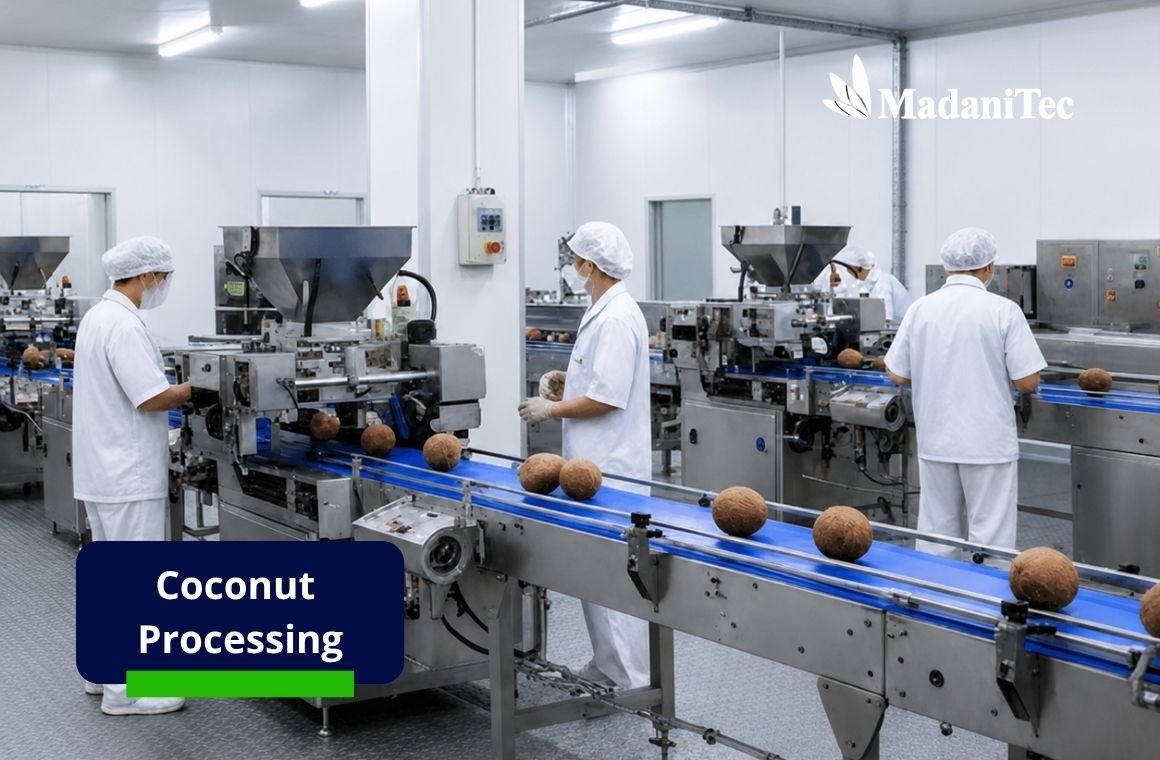
The coconut processing industry continues to evolve as demand grows for a wide range of coconut-based products. However, higher production volumes also bring challenges, particularly in labor requirements, processing time, production capacity, and consistency.
This is where coconut processing technology is becoming increasingly important. Modern machinery and processing equipment can help reduce manual work, streamline production, and support businesses as they handle larger volumes.
Recent research published in Sustainable Food Technology highlights technological innovation, resource efficiency, and better utilization of coconut-processing by-products as important areas for the industry’s future development.
So, how exactly is technology changing the way coconuts are processed? Here are 6 key ways modern technology is transforming the industry.
Why Is Technology Changing the Coconut Processing Industry?
Coconut processing can involve several labor-intensive operations, depending on the product being produced.
Dehusking, shelling, drying, separation, grating, extraction, and material handling may all require significant time and physical effort.
For small-scale operations, traditional methods can still be practical. But as production volumes increase, relying entirely on manual processes can create bottlenecks.
Dehusking is a good example. Agricultural research describes traditional coconut dehusking as a difficult and time-consuming operation that requires considerable physical effort and skill.
This has encouraged the development of powered and mechanical systems designed to improve the process.
The role of technology, therefore, is not simply to replace workers. It is to make the overall production system more productive, consistent, and scalable.
How Is Coconut Processing Done?
The exact processing sequence depends on the final product, but a simplified coconut-processing workflow can be represented as:
Harvesting → Dehusking → Shelling → Separation → Drying or Further Processing → Final Product
For some products, additional stages may include grating, pressing, extraction, filtration, heating, or packaging.
Dehusking is generally one of the first important steps because removing the outer husk allows the coconut to move into subsequent processing stages.
FAO resources describe coconut processing as a sequence in which the outer covering and shell are removed before further processing of the kernel.
The important point is that every stage contributes to the performance of the overall processing line. If one stage becomes a bottleneck, it can affect the stages that follow.
Learn more about: What Can Coconut Husks Be Used For? Exploring Their Hidden Potential
6 Ways Technology Is Transforming Coconut Processing
1. Reducing Repetitive Manual Work
One of the clearest advantages of mechanization is its ability to handle repetitive and physically demanding operations.
Instead of requiring workers to repeatedly perform the same high-effort movement, suitable equipment can take over specific tasks while operators focus on feeding materials, monitoring the process, quality control, and other responsibilities.
Research into powered coconut dehuskers illustrates this shift. Mechanical designs have been developed specifically to reduce the physical demands and time associated with traditional dehusking.
The objective is not necessarily a fully automated factory. In many cases, mechanizing the most demanding stages can already make a significant difference.
2. Improving Production Flow
Processing speed is only one part of productivity. What also matters is how smoothly material moves from one stage to another.
When workers must repeatedly stop, reposition materials, or wait for another operation to finish, production can slow down even when individual tasks appear simple.
Well-designed equipment can help create a more predictable workflow. For businesses handling larger volumes, this can reduce bottlenecks and make production planning easier.
This is particularly important as coconut processors move from small-batch operations toward more continuous or higher-volume production.
3. Creating More Consistent Processing
Manual operations can vary from one worker to another. Differences in experience, technique, fatigue, and working speed may affect the consistency of the process.
Mechanical systems can provide more repeatable movements and operating conditions. That does not automatically guarantee a better final product, but it can create a more controlled processing environment.
Consistency becomes especially valuable when a business supplies customers regularly and needs predictable production results.
4. Supporting Larger Production Volumes
A growing coconut-processing business eventually faces a capacity question:
Can the existing processing method keep up with the available raw material?
Adding more workers may provide a temporary solution, but it may not be the most scalable approach when production continues to increase.
Mechanical equipment allows businesses to plan capacity around the required processing volume.
Research and development in coconut dehusking, for example, has produced systems designed around powered operation and higher processing throughput.
This makes mechanization particularly relevant for processors looking to move from small-scale production toward larger operations.
5. Making Better Use of Resources
Modern coconut processing is also becoming increasingly concerned with what happens to materials that are not part of the primary product.
Husk, shell, coconut water, testa, and other processing residues can represent significant resource streams.
A recent review in Sustainable Food Technology argues that better utilization of these materials can support waste-to-value strategies and a more circular coconut industry.
Another 2026 review in Food Research International highlights technological pathways for converting coconut-processing residues into functional materials, construction products, bio-based ingredients, and other higher-value applications.
This changes the way processors think about waste. Instead of asking only “How do we dispose of this residue?”, businesses can increasingly ask “What else can this material become?”
6. Opening the Door to Value-Added Processing
Perhaps the most important transformation is the shift from simply processing more coconuts to creating more value from each coconut.
Technology can support additional stages such as separation, drying, extraction, size reduction, filtration, and other operations needed to produce specialized coconut-based products.
This creates opportunities for processors to move further along the value chain rather than selling only raw or minimally processed materials.
The result is a more flexible production model in which equipment supports not only higher throughput, but also product diversification and value creation.
What Should Businesses Consider Before Adopting New Technology?
Technology should be selected according to the actual needs of the operation.
Before investing in coconut processing equipment, businesses should evaluate:
- Daily processing volume
- Required machine capacity
- Available labor
- Workspace and layout
- Energy requirements
- Maintenance needs
- Product specifications
- Future production targets
A machine with the highest theoretical capacity is not necessarily the right choice. The better option is equipment that fits the actual production workflow, raw-material supply, operating conditions, and future growth plans.
This is particularly important for small and medium-sized processors, where an equipment investment needs to deliver practical productivity gains rather than simply adding another machine to the production floor.
Conclusion
The transformation of coconut processing is not simply about replacing traditional tools with machines.
It is about building a more efficient, consistent, scalable, and resource-conscious production system.
From reducing repetitive labor and improving production flow to supporting higher volumes, better resource utilization, and value-added processing, technology is changing how businesses approach the coconut value chain.
Recent research suggests that the next stage of the industry will depend not only on higher productivity, but also on better resource efficiency, waste utilization, and circular production models.
For processors planning to expand, the important question is therefore not simply how many coconuts can be processed, but how intelligently the entire process can be designed to create greater value from every batch.
That is where the right processing technology can make a meaningful difference.
Madanitec — providing technology and machinery solutions to support waste processing and the development of circular economy-based businesses, Indonesia’s waste issues.
Affordable prices and reliable quality are supported by after sales service and warranty with every purchase. Do not hesitate to contact 081215778768 via WhatsApp and get a special offer today.