Agriculture is changing rapidly as farmers and agricultural businesses face growing demands for food production, resource efficiency, and environmental sustainability. Technology is becoming an important part of this transition, helping producers make better decisions while using water, energy, land, and other resources more efficiently.
Understanding sustainable agriculture technology trends can help farmers and agricultural businesses identify practical opportunities to improve productivity while preparing for the future of farming.
Why Does Sustainable Agriculture Need Technology?
Traditional farming practices can face challenges related to water availability, labor, climate variability, soil quality, and agricultural waste.
Technology can help address some of these challenges by providing better data, automation, monitoring, and resource-management solutions.
Rather than replacing farmers, modern agricultural technology can support decision-making and make farming operations more precise, measurable, and efficient.
7 Sustainable Agriculture Technology Trends
1. Precision Agriculture and Smart Farming
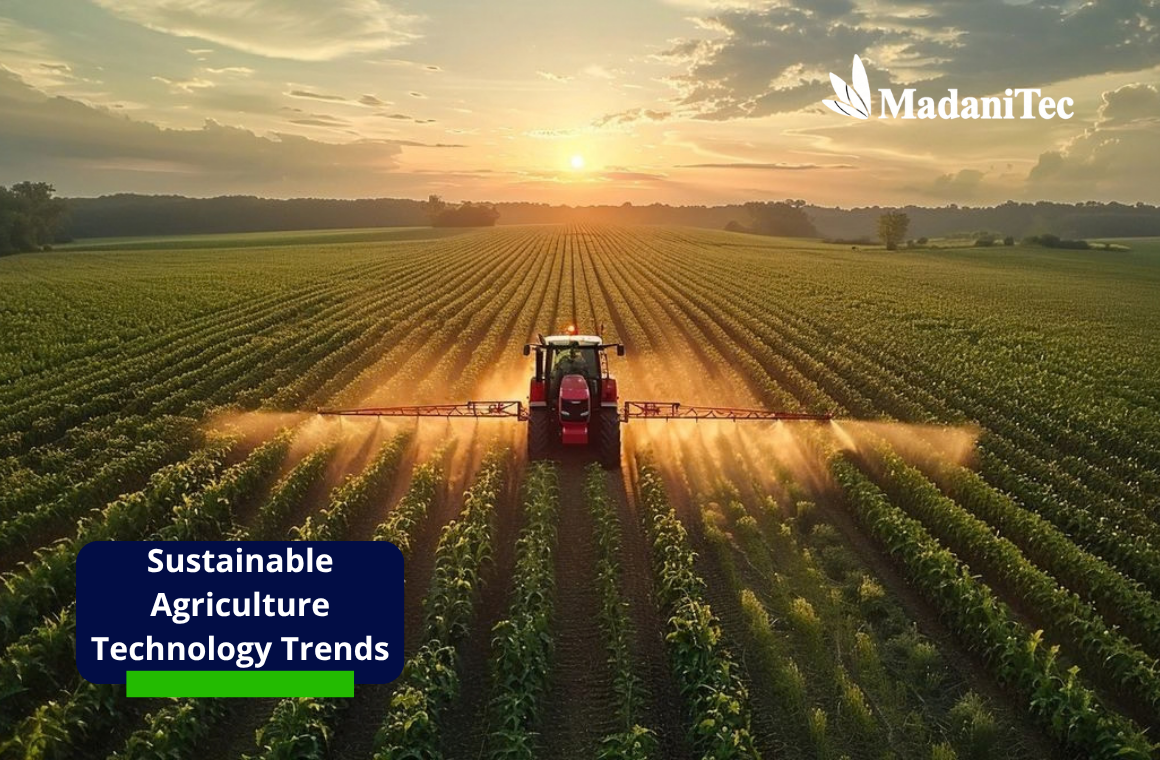
Precision agriculture uses data and technology to help farmers manage crops according to specific field conditions.
GPS, sensors, satellite imagery, and monitoring systems can provide information about soil, crops, and field conditions.
This approach can help farmers apply water, fertilizers, and other inputs more accurately instead of treating an entire field in exactly the same way.
2. AI and Data-Driven Agriculture
Artificial intelligence and data analytics are becoming increasingly relevant to agriculture.
By analyzing information from weather systems, sensors, crop monitoring, and historical production data, AI-based tools can help identify patterns and support agricultural decision-making.
These technologies may assist with crop monitoring, disease detection, yield forecasting, and resource planning.
3. Smart Irrigation Systems
Water efficiency is an important part of sustainable farming. Smart irrigation systems use sensors, weather information, and automated controls to manage irrigation according to actual crop and soil conditions.
Instead of relying only on fixed irrigation schedules, farmers can use real-time information to determine when and how much water is needed.
4. Agricultural IoT and Connected Equipment
The Internet of Things (IoT) allows agricultural sensors and equipment to exchange data through connected systems. Sensors can monitor variables such as soil moisture, temperature, humidity, and environmental conditions.
Connected agricultural systems can give farmers better visibility into operations and help them respond more quickly when conditions change.
5. Renewable Energy for Farming
Renewable energy is another important development among sustainable agriculture technology trends.
Solar power, biomass energy, and other renewable-energy solutions can support agricultural operations that require electricity or thermal energy.
For farms and agricultural businesses, integrating renewable energy can also become part of a broader strategy to improve energy resilience and reduce dependence on conventional energy sources.
6. Agricultural Waste-to-Value Technology
Agricultural waste does not always have to be treated as something with no further value.
Technology can support the processing of residues such as rice husk, crop stalks, shells, and other organic materials into useful products.
Depending on the material and processing method, agricultural residues can potentially be transformed into biomass fuel, soil-related products, composting materials, or other value-added resources.
This approach supports the principles of the circular economy by keeping materials in productive use for longer.
Learn more about: 7 Ide Bisnis Sekam Padi yang Menguntungkan untuk Membuka Peluang Pendapatan Baru
7. Automation and Robotics in Agriculture
Automation and robotics are also changing agricultural operations. Automated systems can assist with repetitive tasks such as planting, monitoring, harvesting, sorting, and material handling.
For agricultural businesses facing labor challenges or seeking greater operational consistency, automation can provide new ways to organize production.
However, implementation should be based on actual operational needs and economic feasibility.
What Do These Trends Mean for the Future of Farming?
The development of these technologies shows that sustainable farming is increasingly connected with data, automation, resource efficiency, and smarter production systems.
The goal is not simply to adopt the newest technology. Farmers and agricultural businesses need to determine which solutions address their specific challenges and provide measurable value.
A small farm, for example, may benefit from smart irrigation and basic monitoring, while a larger agricultural operation may require integrated data systems, automation, or renewable-energy solutions.
Building a More Sustainable Future for Agriculture
The future of agriculture will likely involve a combination of farming knowledge and technological innovation.
By adopting appropriate solutions, agricultural businesses can explore better ways to manage resources, reduce waste, and improve operational efficiency.
For businesses looking to develop agricultural processing or resource-utilization solutions, Madanitec can be considered as a technology partner based on specific production needs.
The most suitable solution should begin with understanding the material, production goals, available resources, and long-term business objectives.
Ultimately, the most valuable sustainable agriculture technology trends are those that can connect innovation with practical agricultural needs and create lasting value for both businesses and the environment.
For consultations regarding machines and appropriate technology solutions for various processing and production needs, please contact the Madanitec team via WhatsApp at 081215778768.