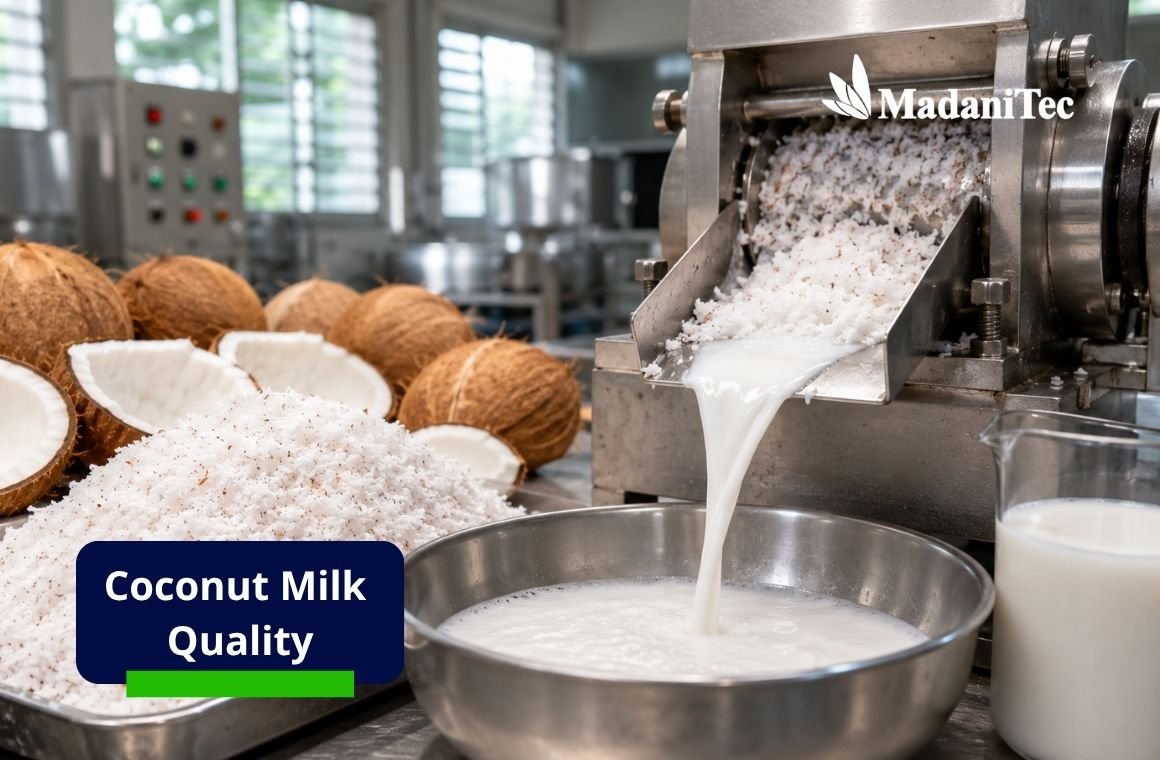
Coconut milk can look simple, but producing a consistent result is not always as straightforward as it seems. Two batches made from coconuts that appear similar can produce coconut milk with different thickness, yield, texture, and overall characteristics.
This happens because coconut milk quality is influenced by more than the coconut itself. The maturity and preparation of the coconut, the amount of water used, extraction pressure, processing time, and the extraction method can all affect the final result. Research has shown, for example, that extraction pressure and holding time can influence the amount of coconut milk obtained from fresh coconut kernels.
Understanding these factors is important, particularly for businesses that need to produce coconut milk repeatedly with a relatively consistent result.
Why Can Coconut Milk Quality Vary?
The quality of coconut milk starts with the raw material, but the process determines how effectively its components are extracted.
Coconut maturity is one factor worth considering. As coconuts mature, the characteristics of their flesh and internal composition change. Research on coconut maturity has demonstrated that maturity can influence the physicochemical composition of coconut products.
This means that using coconuts at different maturity stages can contribute to variations in the characteristics of the extracted milk.
The preparation process matters as well. Differences in how the coconut meat is grated, mixed, and pressed can change how easily the liquid is released from the material.
Learn more abaout: What Can Coconut Husks Be Used For? Exploring Their Hidden Potential
What Determines Coconut Milk Quality?
There is no single factor that determines coconut milk quality. Instead, several parts of the process work together.
Coconut Variety and Maturity
Different coconut varieties can have different physical and chemical characteristics. Maturity also changes the composition of the coconut as the fruit develops.
For this reason, businesses aiming for consistent production should ideally work with relatively uniform raw materials rather than mixing coconuts with substantially different characteristics.
Coconut Meat Preparation
Before extraction, the coconut flesh needs to be prepared properly.
Grating increases the exposed surface area of the coconut meat, making it easier for the liquid components to be released during pressing. The size and consistency of the grated material can therefore influence how the material behaves during extraction.
Research examining different pre-treatments of fresh coconut kernels found that preparation methods can affect several quality attributes of the resulting coconut milk.
Water Ratio
Water is commonly used during coconut milk preparation, but the amount should be controlled according to the desired product.
Too much water can produce a more diluted extract, while too little may make the extraction process more difficult. The appropriate ratio ultimately depends on the type of coconut milk being produced and the intended application.
This is why consistency in the amount of water used can be just as important as consistency in the raw material.
Extraction Pressure
Pressure is another important part of the process.
It might seem logical that applying more pressure would always produce more coconut milk. However, the relationship is not necessarily that simple.
One study found that milk extraction increased with pressure and holding time, but increases above a certain pressure were not statistically significant. At very high pressure, the researchers also observed problems with the cloth bag containing the grated coconut.
The lesson is important: effective extraction is not simply about using the highest possible pressure. The pressure needs to be appropriate for the material, equipment, and processing conditions.
Does Extraction Pressure Affect Coconut Milk Quality?
Pressure can influence the extraction process, but it is important to distinguish between extraction pressure and homogenization pressure.
During extraction, pressure helps separate liquid from grated coconut material. During later processing, homogenization can affect properties such as particle distribution, viscosity, and emulsion stability.
Research on high-fat coconut milk found that homogenization pressure influenced rheological and optical properties of the product.
Therefore, pressure should be viewed as one part of a larger processing system rather than the only indicator of quality.
Why Is Consistency Important in Coconut Milk Production?
For household use, small variations may not be a major concern. Commercial production is different.
A food business may need coconut milk with relatively consistent characteristics from one production batch to another.
Significant variations can affect recipes, texture, processing behavior, and the amount of coconut milk obtained from a given quantity of raw material.
Consistency also makes production easier to control. When the raw material, water ratio, extraction method, and processing time are reasonably standardized, it becomes easier to identify why a particular batch performs differently.
In other words, consistency is not only about product quality; it is also about production control.
What Happens When Coconut Milk Extraction Is Inconsistent?
Imagine producing coconut milk today using one pressing method and repeating the process tomorrow with a different pressure or amount of water.
The result may not be identical.
One batch could be thicker, another more diluted, while another may produce a different amount of liquid from the same general quantity of coconut.
For a small operation, these differences may be manageable. As production grows, however, repeated variations can become more difficult to control.
This is where process standardization becomes increasingly valuable.
Manual vs Mechanical Extraction: Which Provides More Consistency?
Manual extraction has an important advantage: it is simple and requires relatively little equipment. For small-scale production, it can be perfectly practical.
The challenge appears when the volume of coconut increases.
Manual pressing depends heavily on the operator’s technique, physical effort, pressing time, and consistency. Maintaining exactly the same conditions throughout a large production run can therefore be difficult.
Mechanical extraction introduces a more controlled approach. A machine can help standardize important parts of the process, particularly when production is repeated at a larger scale.
However, mechanical extraction should not be viewed as a guarantee of perfect quality. Raw material, preparation, water ratio, machine condition, and operating parameters still matter.
How Can Businesses Improve Coconut Milk Extraction Consistency?
Businesses can start with relatively simple improvements:
- Use coconuts with relatively consistent maturity and quality.
- Standardize the preparation and grating process.
- Maintain a consistent water-to-coconut ratio.
- Establish suitable extraction pressure and processing time.
- Keep equipment clean and properly maintained.
- Monitor the quantity and characteristics of the resulting coconut milk.
- Adjust the process according to the intended final product.
The objective is not necessarily to maximize every parameter. Instead, the goal is to establish a process that produces predictable results for the intended application.
When Should You Consider a Coconut Milk Extractor Machine?
The need for a Coconut Milk Extractor Machine usually becomes more apparent when production starts growing.
If a business is processing larger quantities of coconut every day, manual extraction can become increasingly demanding in terms of time and labor. Repeated production can also make consistency more difficult to maintain.
At this stage, mechanical extraction can be considered as part of a broader production strategy.
The right equipment should be selected based on factors such as production capacity, coconut preparation, desired output, available labor, operating frequency, and the type of coconut milk being produced.
Rather than asking whether a machine is automatically better than manual processing, a more useful question is:
Does the current extraction method provide the capacity and consistency that the business actually needs?
Conclusion — Consistency Starts with the Extraction Process
Coconut milk quality does not depend on a single factor.
Raw material, coconut maturity, preparation, water ratio, pressure, processing time, and extraction method can all influence the final result.
For small-scale production, manual extraction may still be practical. But as production increases, controlling these variables becomes increasingly important.
A consistent coconut milk production process therefore begins long before the final product reaches the container. It starts with choosing suitable raw materials and continues through preparation, extraction, and process control.
Ultimately, better consistency is not about applying the most pressure or using the most sophisticated equipment. It is about matching the extraction process to the material, production scale, and final product requirements.
Madanitec — providing technology and machinery solutions to support waste processing and the development of circular economy-based businesses, Indonesia’s waste issues.
Affordable prices and reliable quality are supported by after sales service and warranty with every purchase. Do not hesitate to contact 081215778768 via WhatsApp and get a special offer today.