As the amount of waste continues to increase, recycling facilities face a growing challenge: how to separate different types of materials efficiently before they enter the next stage of processing. Mixed waste can contain plastics, paper, organic materials, metals, textiles, and other materials that require different handling methods.
Traditional manual sorting can be useful for certain operations, but it may become difficult to maintain when waste volumes increase. This is where waste sorting technology can play an important role. By combining mechanical systems, conveyors, sensors, and automated processes, modern sorting systems can help improve material separation and create a more consistent recycling workflow.
Why Waste Sorting Matters in the Recycling Process
Waste sorting is one of the most important stages in the recycling process because different materials require different processing methods.
When recyclable materials are mixed together, contamination can reduce their quality and make further processing more difficult.
Effective material separation helps recycling facilities identify and recover materials that still have economic value. It can also help prepare materials for subsequent processes such as shredding, compacting, washing, or other forms of treatment.
For this reason, efficient sorting is not simply about separating waste. It is about creating a better-quality material stream that can move more effectively through the rest of the recycling process.
Learn more about: The Hidden Cost of Mixed Waste: Why Proper Separation Matters
What Is Modern Waste Sorting Technology?
Modern waste sorting technology refers to systems and equipment designed to identify, separate, and organize different waste materials more efficiently than conventional manual methods.
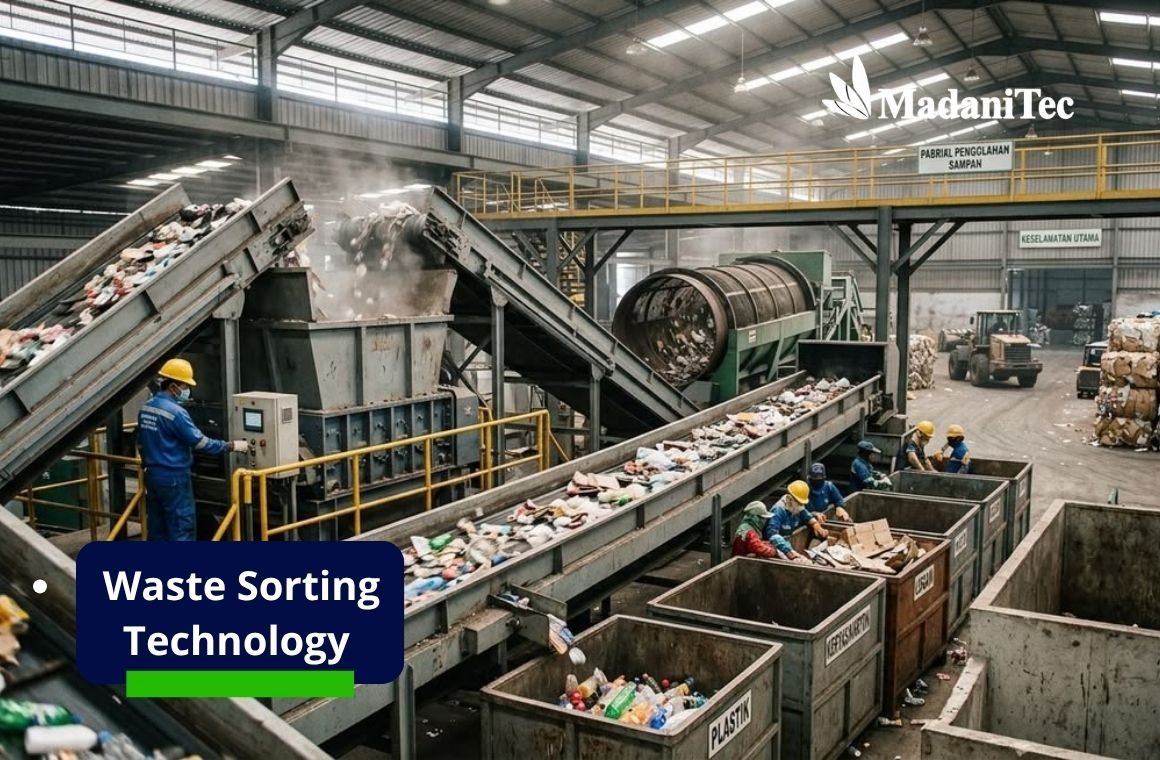
Depending on the facility and type of waste being processed, a sorting system may combine conveyor systems, mechanical separation equipment, sensors, and automated mechanisms.
The specific configuration can vary according to material composition, processing capacity, and the desired level of separation.
Unlike purely manual sorting, automated systems can perform repetitive separation tasks continuously. This can help facilities handle larger material flows while maintaining a more consistent processing pattern.
However, automation does not necessarily eliminate the role of workers. Manual inspection and quality control can remain important, particularly when dealing with complex or contaminated waste streams.
How Automated Waste Sorting Systems Work
Feeding and Conveying
The process generally begins with feeding the waste material into the sorting line. Conveyor systems then move the material through different stages at a controlled flow rate.
A well-designed conveying system helps distribute materials consistently and ensures that they reach the appropriate sorting stages.
Material Detection
The next stage involves identifying material characteristics. Depending on the application, detection can involve physical properties such as size, shape, weight, or other identifiable characteristics.
The purpose is to distinguish different material categories so they can be directed to the appropriate separation stage.
Material Separation
Once materials are identified, mechanical or automated mechanisms can separate them into different streams. The separation method depends on the type of waste and the requirements of the recycling facility.
Effective separation can reduce unwanted materials in each stream and improve the quality of materials prepared for further processing.
Further Processing
After sorting, the separated materials can be directed to additional processing equipment. Depending on the material, this may include shredding, compacting, washing, or other recycling processes.
This creates a connected workflow in which sorting becomes an important first step toward more efficient material recovery.
Benefits of Modern Waste Sorting Technology
Improved Recycling Efficiency
A structured sorting system can help organize the flow of recyclable materials and reduce unnecessary manual handling. When materials are separated earlier, subsequent processing stages can operate with more predictable input.
Better Material Recovery
Efficient separation can make it easier to recover recyclable materials from mixed waste. Materials that might otherwise be discarded can potentially be redirected into appropriate recycling streams.
Reduced Manual Handling
Automated sorting can reduce the amount of repetitive manual work required, particularly in facilities processing large volumes of waste.
Workers can instead focus on monitoring, quality control, maintenance, and other tasks that require human judgment.
More Consistent Processing
Consistency is another important advantage. Automated systems can maintain a defined processing flow, helping facilities achieve more predictable material separation and downstream processing.
Manual vs Automated Waste Sorting: Which Is Better?
The choice between manual and automated sorting depends on the specific needs of a recycling operation.
Manual sorting can be a practical option for smaller facilities or materials that require direct visual inspection. It generally requires lower initial investment and offers greater flexibility when the type of material changes.
Automated sorting, on the other hand, can be more suitable for facilities that handle larger volumes of waste and require a more consistent processing flow.
By reducing repetitive manual handling, automated systems can help improve processing efficiency and provide greater scalability.
However, they typically require higher initial investment and depend on the design and capabilities of the system.
The main factors to consider include labor requirements, processing consistency, initial investment, scalability, and flexibility.
Manual sorting offers simplicity and adaptability, while automated sorting provides greater opportunities for continuous and consistent processing.
For many recycling facilities, the most practical solution may not be choosing one approach exclusively.
A combination of automated sorting equipment and human quality control can help balance efficiency, flexibility, and material inspection.
The Future of Waste Sorting Technology
The development of waste sorting technology is closely connected to the broader transformation of the recycling industry.
Automation, sensor-based systems, data monitoring, and AI-assisted technologies are creating opportunities for more precise and efficient material separation.
Future recycling facilities are likely to focus not only on processing more waste, but also on recovering a greater percentage of usable materials while improving overall operational efficiency.
As recycling requirements become more demanding, integrated sorting and processing systems can become an increasingly important part of modern waste management infrastructure.
Learn more about: Waste Processing Technology Revolution: How Technology Turns Waste into Resources?
Conclusion
Modern waste sorting technology is changing how recycling facilities approach material separation.
By combining conveying, detection, mechanical separation, and further processing, modern systems can help improve recycling efficiency, material recovery, and processing consistency.
The right solution, however, depends on factors such as waste type, processing capacity, facility layout, investment, and operational requirements.
Rather than replacing every manual process, modern sorting technology can work alongside human quality control to create a more efficient and reliable recycling workflow.
Madanitec — providing technology and machinery solutions to support waste processing and the development of circular economy-based businesses, Indonesia’s waste issues.
Affordable prices and reliable quality are supported by after sales service and warranty with every purchase. Do not hesitate to contact 081215778768 via WhatsApp and get a special offer today.