Waste processing is becoming increasingly dependent on efficient material handling. As recycling facilities and waste processing operations handle larger and more diverse volumes of materials, moving waste from one stage to another can become a major challenge. Manual transportation may work for small-scale operations, but it can become inefficient when materials need to move continuously between sorting, shredding, separation, and other processing stages.
This is where a waste processing conveyor plays an important role. By providing a continuous and controlled way to transport materials, conveyors can help connect different stages of a waste processing system while reducing unnecessary manual handling. In modern recycling facilities, this type of equipment can become an important part of a more organized and efficient workflow.
Why Conveyors Matter in Waste Processing
The recycling process involves several stages, from collection and sorting to cleaning and processing recyclable materials.
According to the U.S. Environmental Protection Agency (EPA), collected recyclables are typically transported to recovery facilities where they are sorted, cleaned, and processed before being used again as manufacturing materials.
This means material movement is an essential part of the overall recycling workflow.
Without an appropriate transportation system, materials may need to be moved manually between machines or processing areas.
This can create bottlenecks, increase handling requirements, and make the production flow less consistent.
A conveyor provides a dedicated pathway for material movement. Instead of repeatedly loading and transporting waste manually, materials can move continuously through predetermined processing stages.
This makes the overall system easier to organize and can support a more consistent processing capacity.
Learn more about: How Modern Waste Sorting Technology Is Changing Recycling Efficiency
What Is a Waste Processing Conveyor?
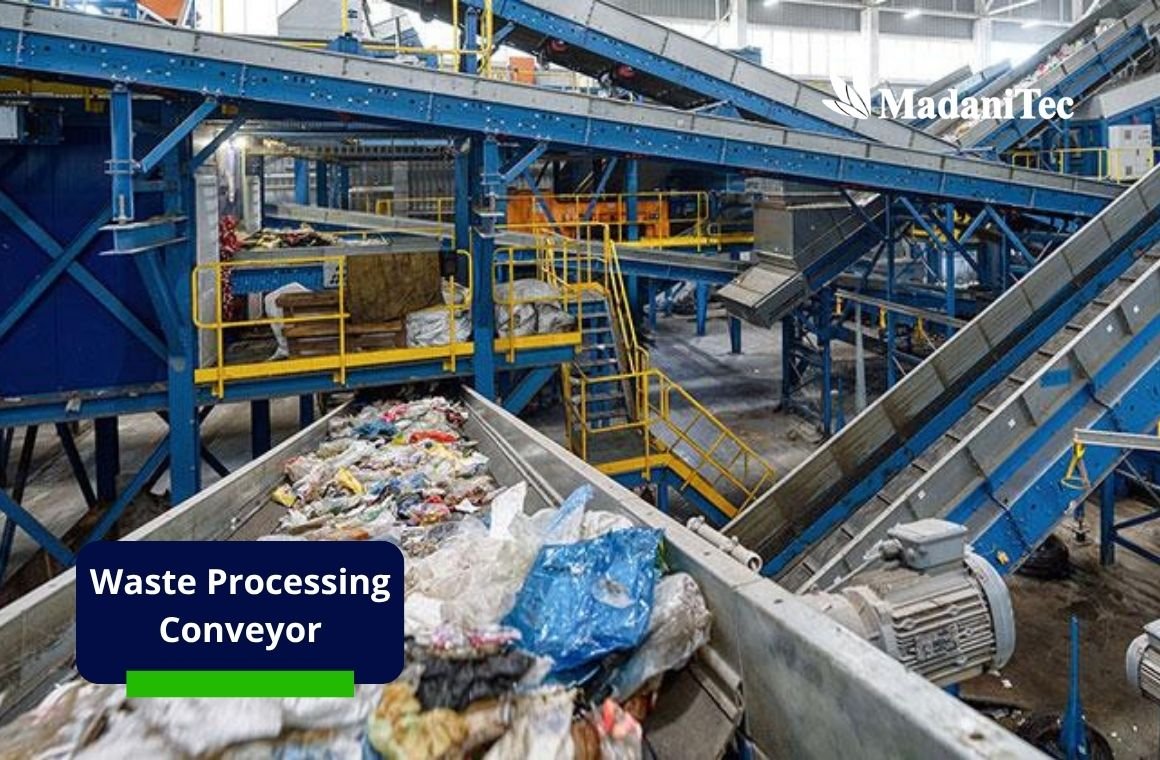
A waste processing conveyor is a mechanical material-handling system designed to transport waste or recyclable materials from one location to another.
In a recycling or waste processing facility, it can be positioned between equipment such as shredders, sorting stations, separators, compactors, and collection points.
The basic concept is relatively simple. A motor-driven system moves a belt or conveying surface, carrying materials along a defined route.
However, the conveyor itself needs to be designed according to the characteristics of the material being processed.
Plastic packaging, cardboard, organic waste, mixed municipal waste, and other materials can have very different weights, shapes, moisture levels, and handling requirements.
Therefore, conveyor width, belt construction, motor capacity, speed, frame design, and loading conditions all need to be considered as part of the system.
How Conveyors Improve Waste Processing Efficiency
Continuous Material Movement
One of the main advantages of a waste conveyor system is its ability to move materials continuously.
Instead of stopping the process each time waste needs to be transferred, a conveyor can maintain a steady flow between processing stages.
Continuous movement is particularly useful when several machines operate as part of one integrated system.
For example, material can move from a feeding area to a sorting station and then continue toward shredding or further processing without requiring repeated manual transportation.
This can help reduce unnecessary waiting time and keep equipment working as part of a more coordinated workflow.
Reduced Manual Handling
Waste processing can involve repetitive lifting, carrying, and transferring of materials. A conveyor reduces the need for workers to perform these tasks manually.
This does not necessarily eliminate human involvement. Instead, workers can focus more on activities that require observation, quality control, equipment monitoring, and decision-making.
Reducing unnecessary manual handling can also support a safer working environment when the conveyor system is properly designed and operated.
OSHA identifies conveyor pinch points and moving components as potential hazards and recommends appropriate guarding, emergency stopping systems, inspection, and lockout procedures.
Better Workflow Integration
A conveyor becomes even more valuable when it is integrated with other processing equipment. Rather than functioning as an isolated machine, it can serve as the connection between different stages of a waste processing system.
For example, a conveyor can transport material from a shredder to a screening machine or move separated materials toward different collection areas.
This creates a more structured material flow and allows equipment to work together as a complete processing line.
More Consistent Material Flow
Consistency is another important factor in industrial processing. Feeding too much material into a machine at once can cause overloads, while an insufficient supply can leave equipment underutilized.
A properly configured conveyor can help regulate the movement of material and provide a more predictable feed to downstream equipment.
The result is a workflow that is easier to monitor and adjust according to processing requirements.
Key Factors to Consider When Choosing a Waste Processing Conveyor
Material Type
The first consideration is the material being transported. Lightweight plastic, cardboard, organic waste, and mixed waste may require different conveyor configurations.
Material size, weight, moisture, abrasiveness, and shape should all be considered before selecting the conveyor.
Processing Capacity
The conveyor must be capable of handling the required material volume. Capacity should be evaluated together with belt width, conveyor speed, loading conditions, and the capacity of connected machines.
Choosing a conveyor with insufficient capacity can create a bottleneck, while excessive capacity may result in unnecessary equipment and energy costs.
Conveyor Length and Layout
Available space also influences conveyor design. The system may need to transport materials horizontally, incline them to another processing stage, or follow a specific plant layout.
A well-planned layout can reduce unnecessary movement and make the entire processing line easier to operate and maintain.
Belt and Drive System
The belt material and drive system should match the operating conditions. Heavy or abrasive waste may require a stronger belt construction, while wet or sticky materials may require a different surface design.
Motor power and drive components should also be selected according to the conveyor length, load, incline, and expected operating conditions.
Maintenance and Safety
Maintenance should be considered from the beginning, not after installation. Regular inspection of belts, rollers, bearings, motors, guards, and emergency-stop systems can help identify problems before they interrupt operations.
OSHA guidance emphasizes guarding moving parts, providing emergency stop controls, and using lockout/tagout procedures during maintenance or when clearing conveyor jams.
Common Applications of Conveyors in Recycling Facilities
Conveyors can be used in many stages of recycling and waste processing.
Common applications include transporting mixed waste to sorting stations, moving recyclable materials between processing machines, feeding shredders and crushers, transferring separated materials, and carrying processed materials toward storage or compacting areas.
In a materials recovery facility, for example, recyclable materials can be loaded onto conveyor systems and then separated according to material type.
The EPA describes recovery facilities as locations where collected recyclables are sorted, cleaned, and processed before being returned to manufacturing.
The exact configuration depends on the type of waste, required capacity, available space, and level of automation.
The Role of Conveyors in Modern Recycling Systems
Modern recycling is moving toward more integrated and data-driven processing systems.
The European Environment Agency notes that digital technologies are increasingly being used to improve waste management and recover more valuable materials from waste streams.
Automated sorting and other technologies can work with data to optimize processing decisions and improve material recovery.
In this environment, Conveyors provide the physical foundation that connects different technologies.
Sorting sensors, shredders, separators, compactors, and other equipment all depend on reliable material movement to function as part of a continuous system.
For facilities planning to improve their recycling operations, the conveyor should therefore be viewed not simply as a transportation machine, but as an important component of the overall waste processing system.
Conclusion
A waste processing conveyor can play an important role in improving the efficiency, consistency, and organization of recycling operations.
By providing continuous material movement, reducing unnecessary manual handling, and connecting different processing stages, conveyors help create a smoother workflow.
However, choosing the right conveyor requires more than considering its size or motor power.
Material characteristics, processing capacity, plant layout, belt construction, safety features, and maintenance requirements all need to be evaluated.
When properly designed and integrated with other equipment, a conveyor can become an essential part of a modern recycling system—helping facilities move from separate processing steps toward a more continuous, efficient, and scalable operation.
Madanitec — providing technology and machinery solutions to support waste processing and the development of circular economy-based businesses, Indonesia’s waste issues.
Affordable prices and reliable quality are supported by after sales service and warranty with every purchase. Do not hesitate to contact 081215778768 via WhatsApp and get a special offer today.