For decades, manufacturing success was largely measured by one simple question: How much can a factory produce?Higher output often meant greater productivity, stronger business performance, and better competitiveness.
But that equation is changing.
As industries face rising material costs, energy pressures, waste management challenges, and increasing demand for more sustainable production, another question is becoming equally important: How much value can a factory create from the resources it uses?
This is where resource-efficient manufacturing is becoming increasingly important. The goal is not simply to produce less. It is to produce smarter, minimize unnecessary resource consumption, and create more value from every material, unit of energy, and hour of production. The OECD identifies resource efficiency and productivity as important across the entire material lifecycle, from extraction and manufacturing to recovery and disposal.
Manufacturing Is Entering a New Era of Resource Efficiency
From Production Volume to Resource Productivity
Traditional manufacturing often focuses heavily on output. More products, faster production, and higher capacity are usually seen as signs of efficiency.
However, high output does not automatically mean high resource efficiency.
A factory can increase production while also increasing material losses, energy consumption, rejected products, and industrial waste.
The more important measure is increasingly becoming resource productivity—how effectively an organization converts resources into useful products and economic value.
This shift is particularly important as global material use continues to grow. OECD projections indicate that, without stronger action, global material use could rise from about 96 gigatonnes in 2020 to 145 gigatonnes by 2050.
Why Producing More Is No Longer the Only Goal
Manufacturers therefore face a new challenge: improving productivity without simply increasing resource consumption.
This means looking more carefully at raw materials, energy, production time, waste, and the technologies used throughout the manufacturing process.
The question is no longer only “How can we produce more?” but also “How can we produce better with fewer unnecessary resources?”
Learn more about: Industrial Energy Transition: 7 Major Changes Toward Cleaner Energy Sources
The Resources Modern Manufacturing Can No Longer Afford to Waste
Materials, Energy, Time, and Waste
Every manufacturing process depends on resources, but four are particularly important.
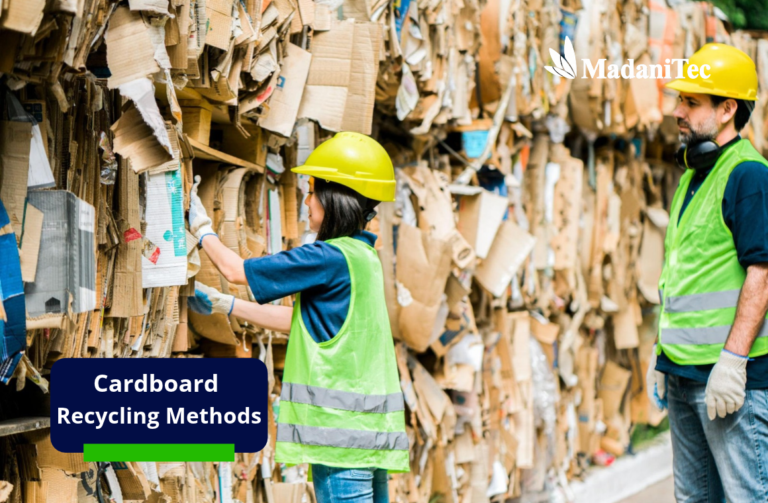
Materials are the foundation of production. Scrap, rejected products, off-cuts, and processing residues represent material that has already required money, energy, transportation, and labor.
Energy is another critical resource. Machines, heating systems, motors, compressors, and processing equipment all consume energy.
Improving energy efficiency can therefore influence both operating costs and environmental performance.
Time is often overlooked. Downtime, inefficient material handling, bottlenecks, and unnecessary processing can reduce productivity even when machinery itself is technically capable of producing at high capacity.
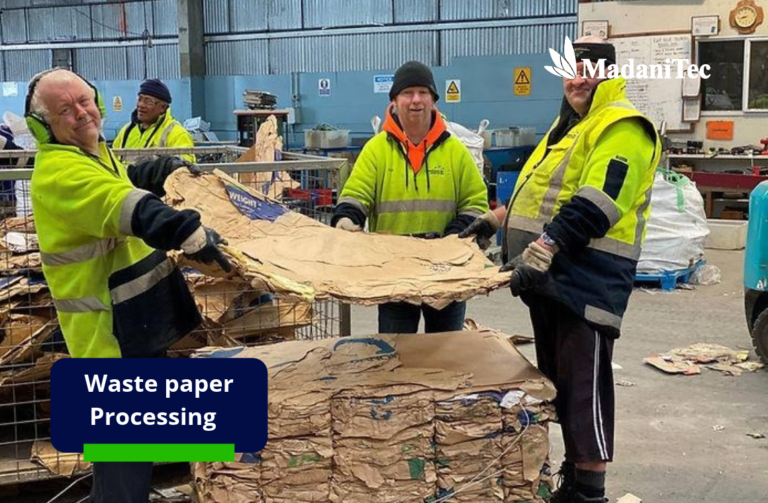
Then there is waste. Waste is not always simply something that needs to be discarded. In many situations, it may contain materials that can be recovered, processed, reused, or redirected into another production cycle.
This is why resource efficiency is increasingly connected to competitiveness, not just environmental responsibility.
UNIDO emphasizes that resource-efficient and cleaner production can help industries reduce waste and pollution while improving productivity and competitiveness.
Why Waste Reduction Is Becoming Part of Manufacturing Efficiency
From Waste Management to Resource Recovery
The traditional approach to industrial waste has often been straightforward: collect it, transport it, and dispose of it.
Modern manufacturing is beginning to ask a different question:
Can this material still create value?
That question changes the entire approach.
Instead of:
Waste → Disposal
the process can become:
Waste → Sorting → Processing → Recovery → Reuse
This is the foundation of resource recovery.
The objective is not necessarily to recycle everything. Different materials require different approaches. Some may be reused directly, some may require mechanical processing, while others may be unsuitable for recovery.
The important change is recognizing that waste management can become part of a broader resource strategy.
How Technology Helps Industries Use Resources More Efficiently
Processing Technology and Material Recovery
Technology plays an important role in making this transition practical.
Modern processing equipment can help industries reduce material losses, process production residues, separate materials, reduce waste volume, and prepare discarded materials for further use.
This is particularly relevant in sectors dealing with plastics, agricultural residues, packaging materials, biomass, and other recoverable resources.
UNIDO describes cleaner production and circular economy approaches as ways to improve resource efficiency, recycle materials, and increasingly design waste out of production systems.
Machines Are Becoming Tools for Resource Optimization
The role of industrial machinery is therefore changing.
A machine is no longer viewed only as equipment for increasing production capacity.
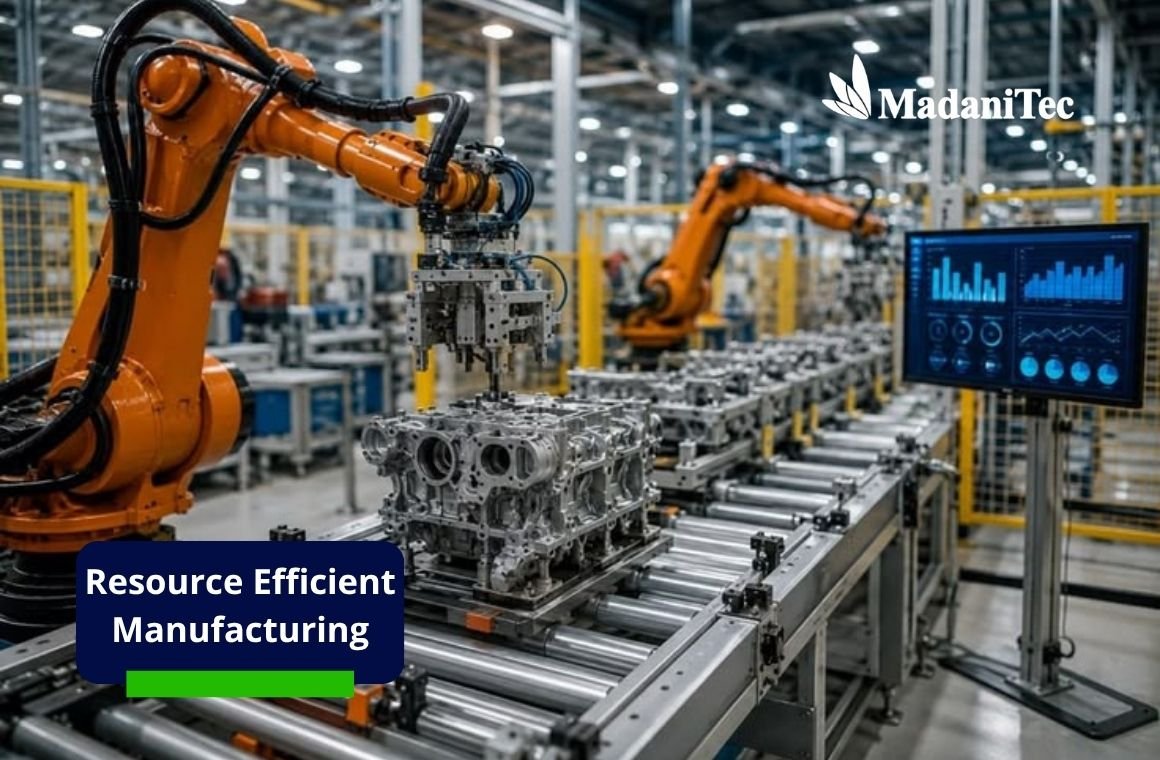
In a more resource-efficient factory, machinery can also become a tool for better material utilization, waste reduction, recovery, and process consistency.
Looking ahead, this role is likely to become even more important as automation, sensors, digital monitoring, and data-driven process optimization become more accessible.
The next generation of factories may increasingly use real-time information to identify material losses, monitor energy consumption, predict maintenance needs, and optimize production processes before inefficiencies become expensive problems.
Learn more about: Waste Processing Technology Revolution: How Technology Turns Waste into Resources?
From Linear Manufacturing to Circular Manufacturing
The Shift From Take-Make-Waste to Recover-and-Reuse
Traditional manufacturing generally follows a linear pattern:
Raw Materials → Production → Product → Waste
Circular manufacturing attempts to keep materials and their value in circulation for longer:
Resources → Production → Product → Recovery → Reprocessing → New Value
This does not mean every factory must become completely circular overnight. Instead, it represents a gradual change in how companies think about materials and waste.
UNIDO notes that circular approaches are increasingly being integrated across industrial value chains, while the OECD highlights resource efficiency and circularity as important elements of a sustainable and competitive economy.
Using Less Does Not Mean Producing Less
Creating More Value From Every Resource
There is an important distinction between using fewer resources and producing fewer products.
Resource-efficient manufacturing aims to improve the relationship between inputs and outputs.
For example, a manufacturer may seek to use less raw material per product, reduce rejected products, recover valuable production waste, consume less energy per unit of output, or reduce downtime.
The result can be a simple but powerful equation:
Better Material Efficiency + Better Energy Efficiency + Better Time Management + Resource Recovery = Greater Industrial Value
The goal is therefore not to slow manufacturing down.
It is to make manufacturing smarter.
The Future of Manufacturing Is About Creating More Value
The future of manufacturing will likely be shaped by a combination of resource efficiency, digital technology, automation, material recovery, and circular production models.
Factories will continue to pursue higher productivity, but productivity itself may increasingly be measured by more than output.
The ability to use materials efficiently, minimize waste, recover valuable resources, and adapt production processes will become increasingly important.
The technologies driving this transition will continue to evolve. Artificial intelligence, industrial sensors, automated sorting, advanced processing systems, predictive maintenance, and real-time production monitoring could make resource optimization far more precise than it is today.
Ultimately, the future of manufacturing is not simply about producing more. It is about producing smarter, wasting less, recovering more, and creating greater value from every resource used.
Madanitec — providing technology and machinery solutions to support waste processing and the development of circular economy-based businesses, Indonesia’s waste issues.
Affordable prices and reliable quality are supported by after sales service and warranty with every purchase. Do not hesitate to contact 081215778768 via WhatsApp and get a special offer today.