Sawdust is one of the most common by-products of woodworking, furniture production, and wood processing activities. Although it is often treated as waste, sawdust can actually be processed into products with useful functions and economic value. This makes sawdust business opportunities worth exploring, especially for small businesses looking for alternative raw materials.
Instead of simply disposing of sawdust, businesses can process it into fuel, composite materials, creative products, and other useful applications. The right approach depends on the type of wood, particle size, moisture content, available technology, and market demand.
Why Is Sawdust Worth Processing?
The growing interest in resource efficiency has encouraged businesses to look at wood residues differently.
Sawdust is relatively easy to collect from woodworking activities, making it a potential secondary raw material when handled properly.
Processing sawdust can provide two benefits at once. First, it can reduce the amount of wood waste that needs to be discarded. Second, it can create additional products that have their own market value.
For entrepreneurs, this creates opportunities to build products from materials that may otherwise have little or no economic value.
7 Ways to Process Sawdust into Valuable Products
1. Turn Sawdust into Wood Briquettes
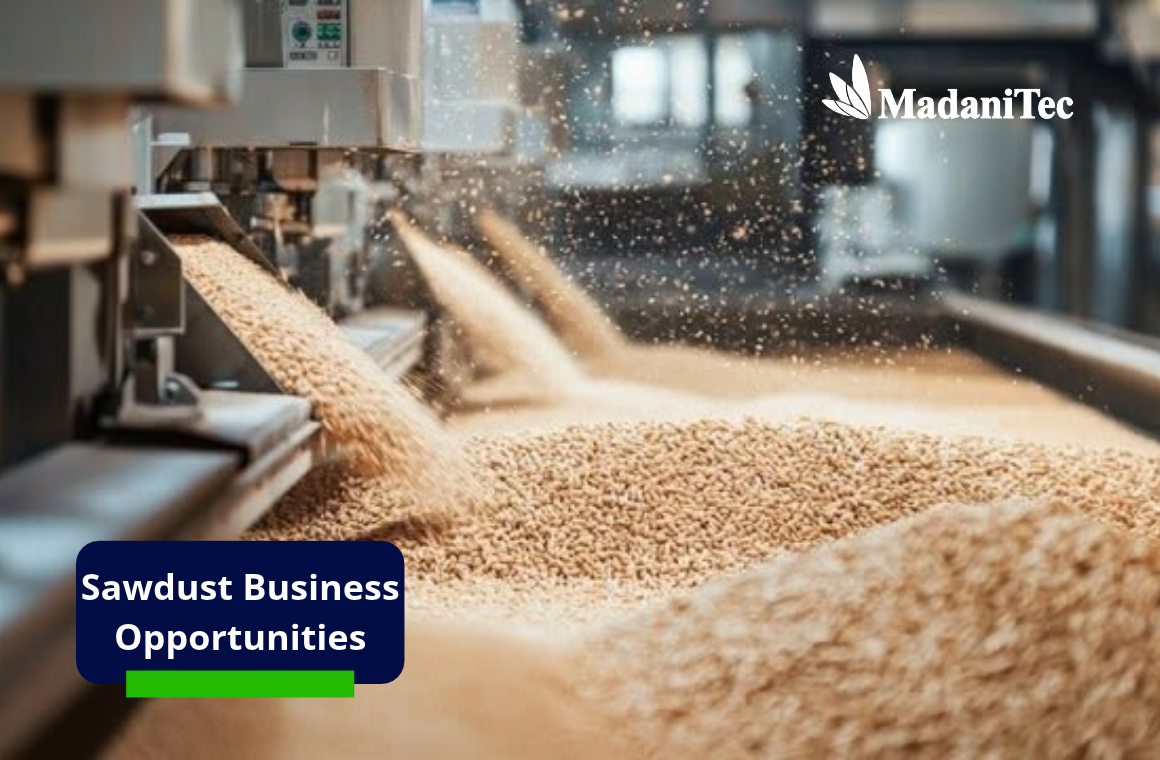
One of the most familiar ways to process sawdust is by turning it into biomass briquettes. Sawdust can be dried, processed, compressed, and formed into briquettes that can be used as a solid fuel.
This application is particularly interesting because compacting sawdust can make storage, transportation, and handling easier.
Businesses can explore local demand from households, food producers, or other users of solid biomass fuel.
2. Make Sawdust Pellets for Biomass Fuel
Sawdust can also be processed into biomass pellets. Unlike loose sawdust, pellets have a more uniform shape and density, which can make them easier to handle and transport.
The pellet market can provide another avenue for sawdust business opportunities, particularly where there is established demand for biomass fuel.
However, consistent raw-material quality and moisture control are important for producing a reliable product.
3. Use Sawdust to Produce Composite Wood Materials
Another option is incorporating sawdust into wood-based composite materials.
Depending on the formulation and production process, wood particles can become part of products designed for construction, furniture, interior applications, or other uses.
This approach demonstrates how sawdust can move beyond its traditional role as a waste material and become part of a new manufactured product.
4. Create Sawdust-Based Decorative and Craft Products
Sawdust can also support creative businesses. Entrepreneurs can experiment with decorative objects, handmade products, ornaments, or other craft applications.
The advantage of this segment is that product value does not necessarily depend on the amount of raw material used. Design, finishing, creativity, and branding can significantly influence the final selling price.
For small businesses, this can be an accessible way to test sawdust business opportunities without immediately building a large-scale production operation.
5. Process Sawdust into Animal Bedding Material
Certain types of clean and suitable wood shavings or sawdust can be used as bedding material for animals. The material can help absorb moisture and provide a dry surface when properly prepared.
However, not all sawdust is automatically suitable for this purpose.
Businesses need to consider the source of the wood, possible chemical contamination, particle characteristics, and the requirements of the intended animal application.
6. Use Sawdust in Composting and Soil Improvement
Sawdust can also be incorporated into organic waste management and composting systems. When properly balanced with other organic materials, carbon-rich wood residues can contribute to the composting process.
This creates another potential use for sawdust, especially for businesses working with organic waste, agriculture, landscaping, or environmental services.
Proper processing is important because simply adding large amounts of fresh sawdust to soil may affect nutrient availability and decomposition conditions.
7. Develop Other Sawdust-Based Products
The possibilities do not end with fuel, composite materials, crafts, or organic applications. Entrepreneurs can continue developing new sawdust-based products based on local resources and customer needs.
For example, businesses can investigate applications in packaging, decorative materials, absorbent products, or other specialized products.
The most promising idea will depend on the characteristics of the available sawdust and the market being targeted.
How Do These Ideas Create Sawdust Business Opportunities?
Turning sawdust into a business requires more than simply finding a way to use the material. Entrepreneurs need to connect the raw material with a product that customers actually need.
Identify the Most Available Type of Sawdust
Start by understanding the source of the sawdust. Different types of wood can have different physical characteristics, moisture levels, and potential applications.
A consistent supply of suitable raw material can also make production planning easier.
Match Sawdust Products with Market Demand
A product may be technically possible to produce but difficult to sell. Therefore, market research should come before investing heavily in production.
Identify potential customers, competitors, expected product specifications, packaging requirements, and acceptable price ranges.
Start Small and Increase Production Gradually
Entrepreneurs can begin by testing a small batch before expanding production. This approach makes it easier to evaluate product quality, production costs, customer response, and potential profit margins.
Once a product demonstrates market demand, production capacity can be increased gradually.
What Should You Consider Before Starting a Sawdust Business?
Several factors should be evaluated before turning sawdust into a commercial product. Raw-material availability is one of the most important because irregular supplies can disrupt production.
Processing requirements should also be considered. Some products require drying, size reduction, mixing, pressing, or other stages before they are ready for the market.
In addition, businesses should calculate production costs, labor, energy consumption, packaging, transportation, and maintenance.
Product consistency is equally important because customers generally expect the same quality from one purchase to the next.
Most importantly, choose an application based on actual market demand rather than simply choosing a product because it can be made from sawdust.
Learn more about: How Can Wood Waste Management Turn Waste Into Valuable Resources?
Turning Wood Waste into a More Valuable Resource
Sawdust does not have to remain a low-value residue from woodworking activities.
With the right processing method and a clear understanding of market needs, it can become a raw material for fuel, composite materials, creative products, organic applications, and other value-added products.
These possibilities show why sawdust business opportunities can be explored as part of a broader approach to waste utilization and resource efficiency.
For businesses that want to develop wood-waste processing or other value-added production activities, choosing the right technology is an important step.
Madanitec can be considered as a technology partner for businesses looking to develop appropriate production solutions based on their raw materials, processing needs, and business scale.
For consultations regarding machines and appropriate technology solutions for various processing and production needs, please contact the Madanitec team via WhatsApp at 081215778768.