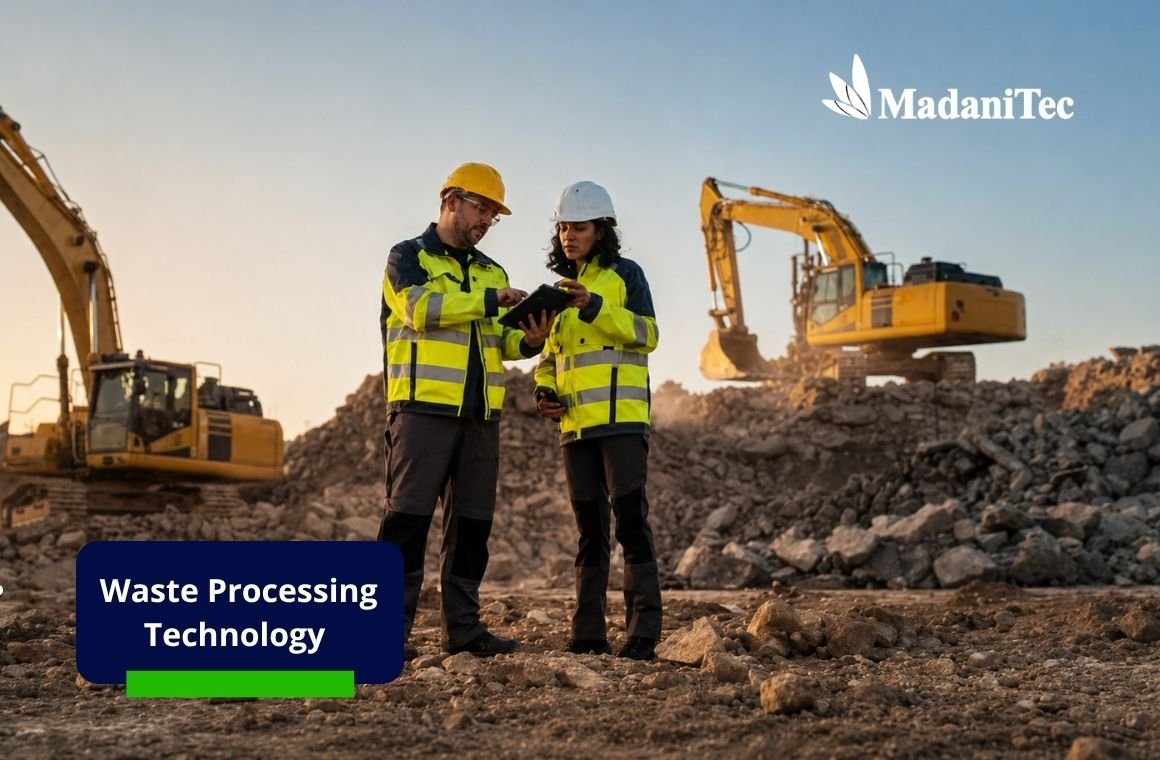
Waste is often seen as something that needs to be collected, transported, and disposed of. However, this traditional approach is gradually changing. Advances in waste processing technology are creating new ways to sort, process, recycle, recover, and even convert waste into useful resources.
The shift is becoming increasingly important as global waste generation continues to grow. According to the United Nations Environment Programme (UNEP), municipal solid waste is projected to increase from around 2.1 billion tonnes in 2023 to 3.8 billion tonnes by 2050.
This means the challenge is no longer simply about where to put waste. The bigger question is how technology can help reduce waste, recover valuable materials, and keep resources in circulation for as long as possible.
Why Does Waste Management Need Technology?
Managing waste manually becomes increasingly difficult as the volume and variety of waste increase. Household waste, industrial waste, plastic, organic materials, textiles, packaging, and other materials require different treatment methods.
Technology can help make these processes more efficient and consistent.
Instead of treating all waste as the same material, modern waste management systems can separate waste according to its characteristics and determine the most appropriate treatment method.
This approach is also closely connected to the circular economy, where materials are kept useful for as long as possible instead of following a simple linear pattern of production, consumption, and disposal.
The World Bank highlights improved waste management, recycling, composting, and resource recovery as important components of more circular waste systems.
Read More About: Indonesia’s Waste Management Crisis: Landfills Are Filling Up—Where Will the Waste Go?
How Has Waste Processing Technology Evolved?
Waste processing has developed from relatively simple manual activities into increasingly mechanized and integrated systems.
In the past, sorting, cutting, compacting, and handling waste often depended heavily on manual labor. Today, machinery can perform many of these tasks faster and with greater consistency.
The development of digital technologies is also opening another stage of innovation.
Research on smart waste management in Indonesia has explored the use of Industry 4.0 technologies, including the Internet of Things (IoT), to improve sorting, transportation, treatment, and decision-making within waste management systems.
The result is a shift from simply handling waste toward managing materials and recovering their value.
What Technologies Are Used in Waste Processing?
Different types of waste require different technologies. There is no single machine or process capable of handling every material efficiently.
Waste Sorting Technology
Sorting is one of the most important stages because the value and treatment method of waste depend heavily on its material composition.
Sorting systems can separate materials such as plastic, paper, metal, organic waste, and other residues.
In waste processing facilities, Automatic Waste Sorting Machine can help improve the consistency and efficiency of separating organic and inorganic materials, particularly when handling larger volumes of mixed waste.
In more advanced facilities, mechanical and automated sorting technologies can be combined with sensors and digital systems to improve material identification.
Better sorting also improves the quality of materials that enter recycling or further processing.
Shredding and Size Reduction Technology
Shredding reduces waste into smaller and more manageable pieces. This process is commonly used for materials such as plastic, organic waste, textiles, and certain industrial residues.
Depending on the material and required output, industrial waste Shredder Machine can be configured to reduce materials to an appropriate size for subsequent processing, including recycling and RDF preparation.
Reducing particle size can make subsequent processes easier, including mixing, transportation, drying, composting, recycling, or preparation for fuel production.
For recycling operations, shredding can therefore become an important step between waste collection and the production of usable secondary raw materials.
Waste Compaction and Baling Technology
Waste compaction and baling technologies reduce the volume of materials, making storage, transportation, and handling more efficient.
For materials such as cardboard, plastic, bottles, and other recyclable waste, Hydraulic Press Machine can compress loose materials into denser forms that are easier to store, transport, and handle.
This is particularly useful for materials that occupy a large amount of space when loosely stored. By increasing material density, businesses can potentially improve logistics efficiency while creating more organized processing facilities.
Waste-to-Energy Technology
Some waste materials that cannot be economically recycled may still contain usable energy. Waste-to-energy technologies can recover energy from certain waste streams through processes such as controlled thermal treatment.
However, waste-to-energy should not be viewed as a universal solution.
UNEP emphasizes that waste-to-energy incineration is only one component of an integrated municipal waste management system and should be evaluated alongside waste reduction, reuse, recycling, and other treatment options.
How Does Technology Make Waste More Valuable?
Technology changes the way waste is viewed.
A mixed pile of waste may have relatively low value because different materials are contaminated and difficult to process.
Once the materials are sorted, cleaned, reduced in size, compacted, or processed, however, some of them can become usable secondary materials.
Plastic can be processed into flakes or other feedstock. Organic waste can become compost or biogas. Certain residual materials can be prepared as alternative fuels.
This is where technology creates an important connection between waste management and resource recovery.
The World Bank’s latest What a Waste 3.0 report also emphasizes that better waste management can support economic development, employment, innovation, and circularity rather than treating waste solely as a cost.
Read More About: Biomass Fuel: Can Agricultural Waste Really Become a Source of Energy?
Can Waste Processing Technology Support the Circular Economy?
Yes, but technology is only one part of the equation.
A circular economy aims to keep products and materials in use for as long as possible. Waste processing technology supports this objective by helping recover materials that would otherwise be discarded.
In Indonesia, the government has increasingly connected circular economy development with waste management, resource efficiency, green jobs, and economic opportunities.
Bappenas has also identified circular economy development and integrated waste management as strategic areas in Indonesia’s transition toward a greener and more sustainable economy.
This means the future of waste management is not simply about building larger disposal facilities. It is increasingly about developing systems capable of recovering more value from materials.
What Are the Challenges of Using Waste Processing Technology?
Despite its potential, technology does not automatically solve every waste problem.
Investment costs, maintenance, operator skills, electricity consumption, material contamination, inconsistent waste supply, and facility design can all influence whether a processing system works effectively.
Technology must therefore be selected based on the characteristics of the waste and the intended output.
For example, a machine designed for rigid plastic may not be suitable for wet organic waste.
Similarly, a shredding system designed for one material may require different configurations when processing textiles or mixed industrial residues.
The most effective approach is to begin with the waste stream, understand its characteristics, and then select the appropriate processing technology.
What Is the Future of Waste Processing Technology?
The future is likely to move toward more integrated, automated, and data-driven waste processing systems.
Sorting, shredding, compacting, recycling, organic treatment, and energy recovery may increasingly become connected within integrated facilities.
Digital monitoring and IoT-based systems could also help operators track material flows, machine performance, and processing efficiency.
At the same time, Indonesia is moving toward more integrated waste management approaches. In 2026,
Bappenas highlighted the development of integrated upstream-to-downstream waste management and even produced tools for evaluating Waste-to-Energy and non-Waste-to-Energy technologies as part of its Sustainable Infrastructure in Asia program.
The direction is clear: waste is increasingly being treated not simply as something to eliminate, but as a potential source of materials, energy, and economic value.
Conclusion
The revolution in waste processing is not about one particular machine or technology. It is about changing the entire way we understand waste.
Sorting technology can separate valuable materials. Shredders can prepare waste for further processing.
Compaction systems can improve logistics. Organic waste technologies can recover biological resources, while waste-to-energy systems can recover energy from selected residual materials.
Together, these technologies can help move waste management from a disposal-oriented model toward a resource-recovery and circular economy approach.
The biggest opportunity is therefore not simply to process more waste, but to process it more intelligently—so that materials once considered worthless can return to productive use.
Madanitec — providing technology and machinery solutions to support waste processing and the development of circular economy-based businesses, Indonesia’s waste issues.
Affordable prices and reliable quality are supported by after sales service and warranty with every purchase. Do not hesitate to contact 081215778768 via WhatsApp and get a special offer today.