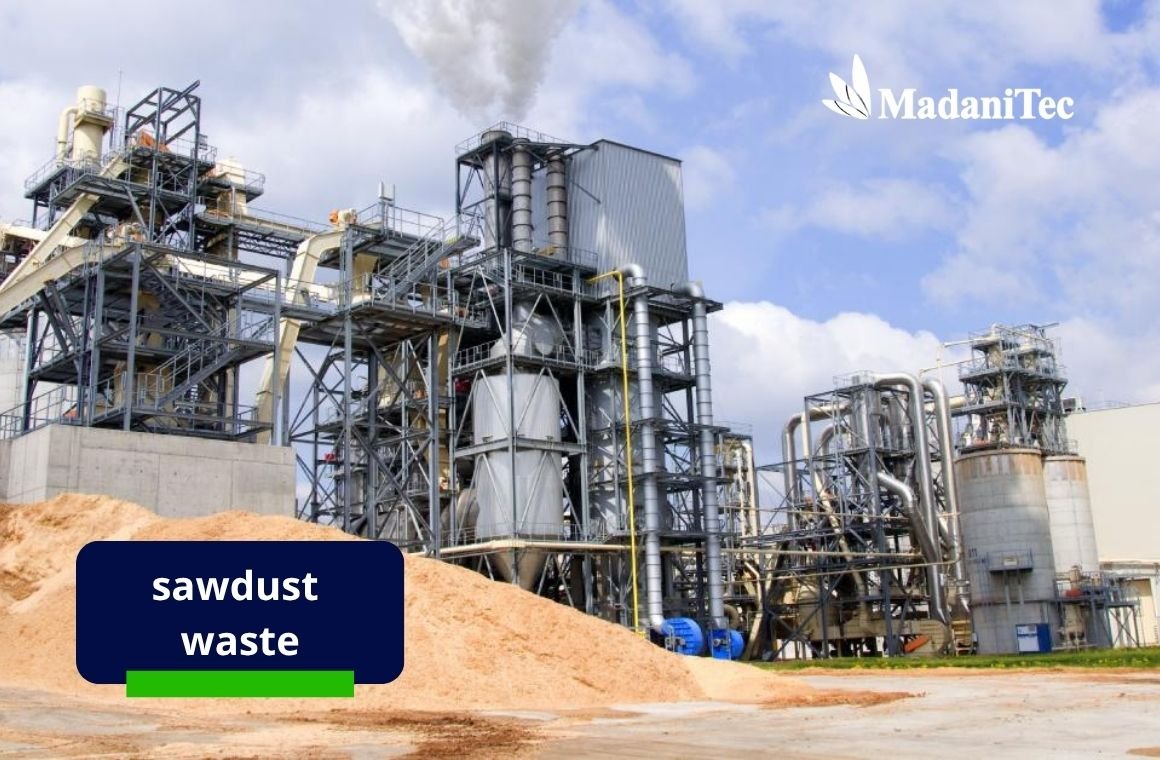
Every woodworking process leaves something behind. Sawing, cutting, sanding, and other wood-processing activities can generate sawdust waste, along with shavings, chips, and other residues. For many businesses, these materials are simply viewed as waste that needs to be stored, transported, or discarded.
But sawdust does not necessarily have to end its journey as waste.
With the right processing methods, these wood residues can become useful raw materials for energy, agriculture, animal bedding, engineered wood products, and other applications. The U.S. Forest Service has documented a wide range of uses for sawdust, shavings, and other wood-processing residues, showing that materials often considered waste can still have practical value.
This makes sawdust a good example of how the right approach can turn a by-product of production into a useful resource.
Why Is Sawdust Considered Waste?
Sawdust is a natural by-product of wood processing. Sawmills, furniture manufacturers, carpentry workshops, and other wood-processing operations can generate considerable quantities of fine wood particles.
The challenge is that sawdust is lightweight and can quickly occupy storage space. Its fine particles can also create dust-management concerns, while mixed or contaminated wood residues may have limited applications.
However, the classification of sawdust as “waste” depends heavily on how it is managed. The U.S. Forest Service notes that wood residues such as sawdust and chips have long been used as raw materials for other industries and products.
In other words, the question is not only how much sawdust is generated, but also what can be done with it.
Why Should Sawdust Be Reused Instead of Discarded?
Reusing sawdust can create another pathway for materials that would otherwise require disposal.
Instead of treating wood residues as an end-of-process problem, businesses can consider them as a secondary raw material.
Depending on their quality, moisture content, particle size, cleanliness, and wood species, sawdust may be suitable for different applications.
This approach is consistent with the broader idea of resource recovery and circular use of materials: extract as much useful value as possible before considering disposal.
However, not every pile of sawdust is automatically suitable for every application. Clean, untreated wood residues are generally more versatile, while treated, painted, contaminated, or mixed materials may require special handling.
Learn more about: Waste Is Increasing, Storage Space Is Shrinking: How to Reduce Waste Volume and Transportation Costs
What Can Sawdust Be Used For?
There are several potential applications for sawdust. The right option depends on the characteristics of the material and the requirements of the final product.
1. Wood Pellets
Wood pellets are one of the most recognizable products made from wood residues.
They are generally produced by compacting sawdust or other wood-processing residues into a consistent shape.
The U.S. Department of Energy’s Alternative Fuels Data Center describes wood pellets as being made from compacted sawdust and other wood residues.
Typical preparation can include chipping, shredding, milling, and other steps to create a more uniform feedstock before pelletizing.
This makes pellet production an example of how loose wood residues can be transformed into a standardized biomass fuel.
2. Biomass Briquettes
Sawdust can also be processed into biomass briquettes.
The basic concept is similar: loose particles are compressed into a denser form that is easier to handle and store.
Depending on the production system, particle preparation, moisture control, and compaction are important factors in determining the quality of the final briquette.
3. Particleboard and Wood-Based Panels
Another important application is engineered wood.
The U.S. Forest Service explains that wood residues such as sawdust and planer shavings can be used in particleboard production.
Manufacturing typically involves preparing and sizing the wood particles, drying and screening them, mixing them with a binder, and forming them under heat and pressure.
This demonstrates that sawdust can become part of a completely different product category rather than simply being burned or discarded.
4. Animal Bedding
Sawdust and wood shavings are also used as bedding materials in some livestock operations.
Their absorbency and physical characteristics can make them useful for bedding, but the source and type of wood matter.
Cornell and other university extension resources emphasize that bedding selection should consider factors such as moisture, cleanliness, particle size, dust, and animal safety.
Untreated, appropriate wood residues should therefore be distinguished from contaminated or unsuitable materials.
5. Compost and Soil Applications
Sawdust can also play a role in certain composting and soil-management applications.
Research indexed by the U.S. EPA has examined sawdust as a component in co-composting systems, while Oregon State University Extension notes that sawdust can be used as mulch in certain agricultural and landscape applications.
However, fresh sawdust can affect plants and soil processes, so aging, leaching, or composting may be appropriate depending on the intended use.
6. Biochar
Sawdust can become a feedstock for biochar production through thermochemical conversion.
The basic process is called pyrolysis, in which biomass is heated under limited oxygen conditions. The resulting products can include biochar, gases, and liquids depending on the process conditions.
USDA research has specifically examined biochar produced from hardwood sawdust, while the International Biochar Initiative identifies pyrolysis as the fundamental process used in many biochar production systems.
7. Composite and Innovative Materials
Beyond conventional products, wood residues can also become ingredients in composite materials and other engineered products.
The characteristics of the particles—such as size, shape, moisture, and cleanliness—can influence how suitable they are for a particular application.
This means processing technology can become an important part of turning low-value residues into more consistent raw materials.
How Is Sawdust Processed into Valuable Products?
Turning sawdust into a useful product usually involves more than simply collecting it.
A typical process may include:
Collection → Sorting → Size Reduction → Drying → Screening → Processing → Final Product
The exact sequence depends on the application.
Sorting and Material Preparation
The first step is to separate unsuitable materials such as stones, metal, plastic, soil, or treated wood.
Size Reduction and Grinding
Particle size may need to be adjusted to meet the requirements of the final product. Industrial wood-residue processing can involve grinding, screening, and other size-control processes.
Drying and Moisture Control
Moisture is another important consideration. Some applications require relatively dry and consistent feedstock, while excessive moisture can affect storage, processing, and final-product quality.
Forming, Pressing, or Conversion
Depending on the application, prepared sawdust may be pelletized, briquetted, pressed into composite products, or converted through thermochemical processes such as pyrolysis.
Can Sawdust Become a Valuable Business Opportunity?
Potentially, yes—but the opportunity depends on more than simply having a large supply of sawdust.
A business needs to consider:
- Availability of raw material
- Consistency of supply
- Moisture content
- Particle size
- Contamination
- Processing costs
- Equipment requirements
- Local market demand
- Final product specifications
The U.S. Forest Service emphasizes that successful wood-residue utilization requires understanding the material’s species, moisture, form, cleanliness, potential markets, and the costs required to upgrade the residue.
Therefore, the most valuable opportunity may not always be the product with the highest selling price. It may be the application that best matches the available raw material and local market.
What Factors Should Be Considered Before Processing Sawdust?
Type of Wood
Different wood species can have different physical and chemical characteristics. Some applications may require specific species or exclude certain types.
Moisture Content
Moisture can affect storage, grinding, combustion, pelletizing, briquetting, and other processing stages.
Particle Size
A uniform particle size can be important when the material will be pressed, pelletized, mixed, or used as a component in another product.
Contamination
Painted, treated, chemically contaminated, or mixed wood should not automatically be treated like clean sawdust. For example, EPA guidance warns against composting or mulching sawdust from certain preservative-treated wood.
Intended End Product
The final application should determine the processing method—not the other way around.
Which Sawdust Innovation Is Right for Your Operation?
There is no single best use for every type of sawdust. The right application depends on the characteristics of the material, the available processing technology, and the type of product you want to produce.
For wood pellets, the process generally requires suitable particle size, controlled moisture, and pelletizing equipment to transform loose sawdust into a more uniform biomass fuel.
For biomass briquettes, drying and compaction are important because the loose sawdust needs to be transformed into a denser and more manageable form.
If the target is particleboard or other wood-based panels, the sawdust needs to be prepared to a suitable particle size before being combined with a binder and formed under pressure.
For animal bedding, cleanliness and suitable particle size become more important. The material should come from an appropriate wood source and be free from harmful contaminants.
Sawdust can also be used in certain compost and soil applications, although the material may need to be processed or mixed appropriately depending on how it will be used.
For biochar, the process is different because the sawdust becomes a feedstock for controlled thermochemical conversion, such as pyrolysis.
Meanwhile, composite materials may require consistent particle size, proper mixing, and forming processes to achieve the characteristics required by the final product.
Ultimately, the best innovation is not necessarily the one that sounds the most advanced. It is the application that matches the quality and availability of your sawdust, processing capabilities, production costs, and market demand.
How Can Technology Improve Sawdust Waste Processing?
Technology becomes increasingly useful when sawdust and other wood residues are generated regularly or in large quantities.
Grinding and size-reduction equipment can help produce more consistent feedstock, while screening can separate particles according to size.
For larger wood residues that need to be reduced before further biomass processing, a High Capacity Wood Chipper can also be used as part of the initial material preparation process.
The important point is that equipment should follow the characteristics of the material and the requirements of the final product.
A machine that works well for preparing wood material for biomass production, for example, may not necessarily be the right choice for producing biochar or particleboard.
For businesses looking to increase the value of their wood residues, the first step is therefore not simply choosing a machine.
It is understanding the material, defining the desired product, and then designing a processing system around those requirements.
Conclusion — Giving Sawdust a Second Life
Sawdust may begin as a by-product of wood processing, but it does not necessarily have to remain a waste material.
From wood pellets and biomass briquettes to particleboard, animal bedding, compost applications, biochar, and composite materials, there are multiple ways to give wood residues a second life.
The key is proper material assessment and processing. When particle size, moisture, cleanliness, wood type, and end-product requirements are understood, sawdust can become a much more useful resource.
The real innovation is not simply finding another place to put sawdust. It is finding a way to turn wood waste into a consistent, useful, and potentially valuable resource.
Madanitec — menyediakan solusi teknologi dan mesin untuk mendukung pengolahan limbah dan pengembangan bisnis berbasis ekonomi sirkular, serta mengatasi permasalahan limbah di Indonesia.
Harga terjangkau dan kualitas terpercaya didukung oleh layanan purna jual dan garansi untuk setiap pembelian. Jangan ragu untuk menghubungi 081215778768 melalui WhatsApp dan dapatkan penawaran spesial hari ini.