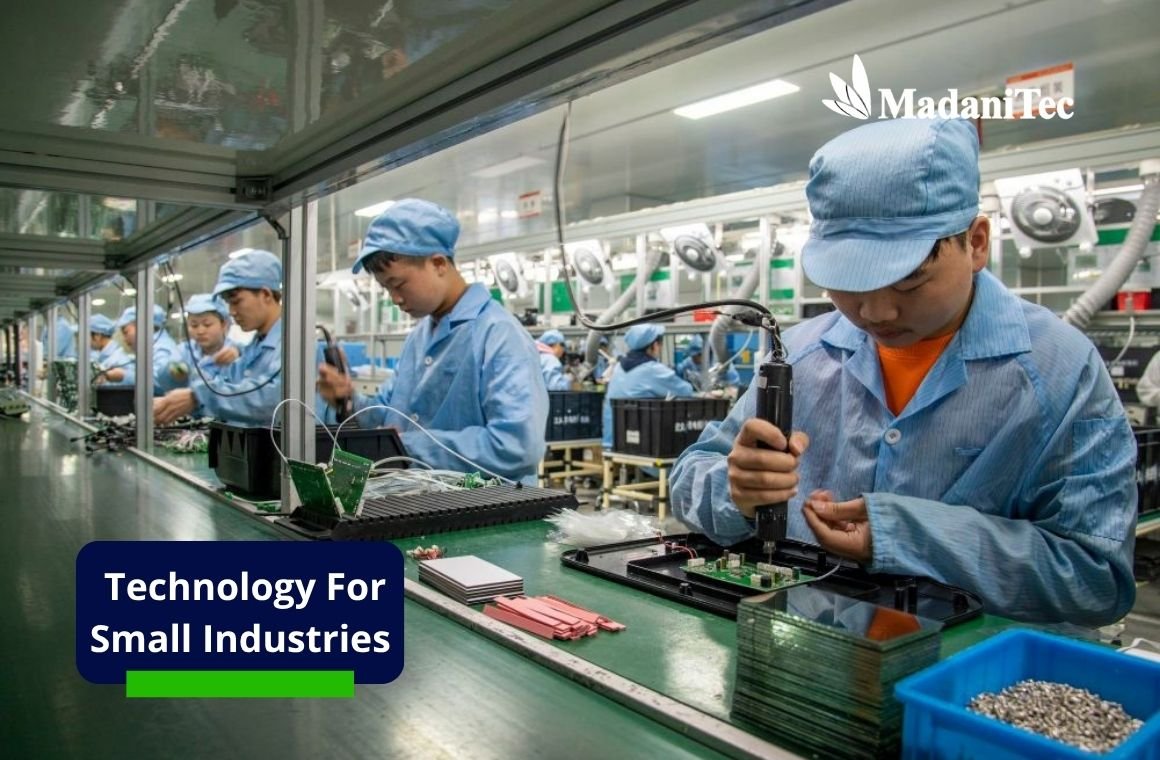
Technology for small industries is becoming increasingly important as manufacturers face growing demand, rising operating costs, and stronger competition. For many small businesses, adopting technology is no longer simply about replacing manual work with machines. It is about finding better ways to improve production efficiency, maintain consistent quality, increase capacity, and create opportunities for sustainable growth.
For small industries, this shift can be significant. Limited labor, changing customer expectations, rising operating costs, and growing competition can make traditional production methods increasingly difficult to maintain. Research on Indonesian micro and small manufacturing firms has found that technology utilization has a significant positive relationship with labor productivity.
Why Are Small Industries Turning to Technology?
Growing Market Demands
Small industries often begin with relatively simple production processes. As demand grows, however, maintaining the same methods can become difficult.
Larger orders may require higher production capacity, more consistent quality, and faster delivery.
Technology can provide an opportunity to increase production capability without simply adding more workers or extending working hours.
UNIDO notes that appropriate technologies can help SMEs improve productivity, product quality, and their ability to meet market requirements.
The Limitations of Manual Production
Manual production still has an important place in many small industries, particularly when products require craftsmanship or flexibility.
However, repetitive manual tasks can consume considerable time and may produce inconsistent results when production volumes increase.
The challenge is therefore not necessarily to eliminate manual work, but to identify which parts of the process can be improved through technology.
The Need to Produce More Without Losing Quality
Growth creates a new challenge: producing more while maintaining product consistency. If production increases faster than process control, quality problems can become more difficult to manage.
Technology can help standardize repetitive processes, making production less dependent on individual physical effort.
Learn more about: Can Technology Help Industries Reduce Waste Without Slowing Production?
How Does Technology for Small Industries Improve Production?
From Manual Work to Mechanized Processes
One of the most visible changes is the transition from purely manual processes toward mechanized production.
Machines can perform repetitive tasks such as cutting, grinding, mixing, pressing, shredding, or processing materials.
This does not necessarily mean replacing workers. Instead, machines can take over physically demanding or repetitive activities while workers focus on supervision, quality control, preparation, and other tasks requiring judgment.
Making Repetitive Tasks More Efficient
Repetitive operations are often suitable for technological improvement because they follow relatively consistent procedures. A properly selected production machine can help maintain a more predictable working rhythm.
This can become especially valuable when an industry needs to increase output without proportionally increasing manual workload.
Improving Production Consistency
Consistency is another important benefit. When a process is controlled more systematically, variations caused by fatigue or differences in manual technique can potentially be reduced.
For small manufacturers trying to build a reliable market reputation, consistent production can be just as important as producing larger quantities.
Increasing Production Capacity
Technology can also help small industries respond to larger orders. Instead of expanding production only by adding workers, businesses can improve the productivity of existing resources.
Research on advanced manufacturing technology in Indonesian SMEs has also examined its potential to improve productivity and expand market opportunities.
Can Technology Help Small Industries Reduce Production Costs?
Reducing Unnecessary Labor and Material Use
Technology does not automatically make production cheaper. However, it can reduce unnecessary manual effort, improve material utilization, and make certain processes more efficient.
The objective should be to reduce avoidable costs rather than simply reduce the number of workers.
Improving Workflow Efficiency
A well-designed production system can reduce unnecessary movement between processing stages. Equipment can also be positioned according to the workflow so that materials move more efficiently through the facility.
Minimizing Production Losses
Better process control can help reduce errors, damaged materials, and inconsistent output. Over time, preventing these losses can have a meaningful effect on production costs.
What Types of Technology Can Small Industries Adopt?
Production and Processing Equipment
These include machines designed for specific production activities such as processing, forming, cutting, grinding, pressing, mixing, or material preparation
Automation and Control Systems
Automation can range from simple control mechanisms to more advanced systems that monitor and regulate production processes. Small industries do not necessarily need a fully automated factory to benefit from automation.
Material Handling and Processing Technology
Technology can also improve how raw materials, production residues, and finished products are moved, reduced, sorted, or processed.
Digital Tools for Production Management
Digital technology can support inventory management, production planning, sales, accounting, monitoring, and communication.
OECD research notes that digital technologies can help SMEs improve operational performance, decision-making, automation, and productivity, although smaller firms often adopt more advanced technologies more slowly.
What Are the Challenges of Adopting Technology?
Initial Investment
The cost of equipment or digital systems can be a major consideration for small businesses. Technology should therefore be evaluated based on its actual production needs and potential long-term value.
Choosing the Right Technology
The most advanced technology is not always the best option. A simpler system that solves a specific production bottleneck may provide greater value than a sophisticated system that does not match the business workflow.
Skills and Operator Training
Technology also requires people who understand how to operate, maintain, and troubleshoot it. Training should therefore be considered part of technology adoption.
Maintenance and Long-Term Costs
Purchase price is only one part of the calculation. Maintenance, spare parts, electricity, training, and downtime should also be considered before adopting new technology.
Learn more about: How Modern Waste Sorting Technology Is Changing Recycling Efficiency
How Can Technology Support Long-Term Business Growth?
Technology can give small industries greater flexibility to accept larger orders, maintain consistent quality, and explore new products or markets.
As production becomes more efficient, businesses may have more room to invest in product development, quality improvement, and market expansion.
UNIDO similarly highlights technology adoption as a way for SMEs to improve productivity, quality, and access to new market opportunities.
The Future of Small Industries: Technology as a Growth Tool
Technology for small industries not simply by making machines faster, but by changing how businesses organize production, use resources, manage repetitive work, and respond to customer demand.
The most successful approach may not be to adopt every new technology available. Instead, small industries can focus on identifying their biggest operational challenges and choosing technology that provides a practical solution.
For a small manufacturer, technology can therefore become more than a production tool.
When selected and implemented carefully, it can become part of a broader strategy for improving efficiency, maintaining quality, increasing capacity, and creating new opportunities for sustainable business growth.
Madanitec — providing technology and machinery solutions to support waste processing and the development of circular economy-based businesses, Indonesia’s waste issues.
Affordable prices and reliable quality are supported by after sales service and warranty with every purchase. Do not hesitate to contact 081215778768 via WhatsApp and get a special offer today.